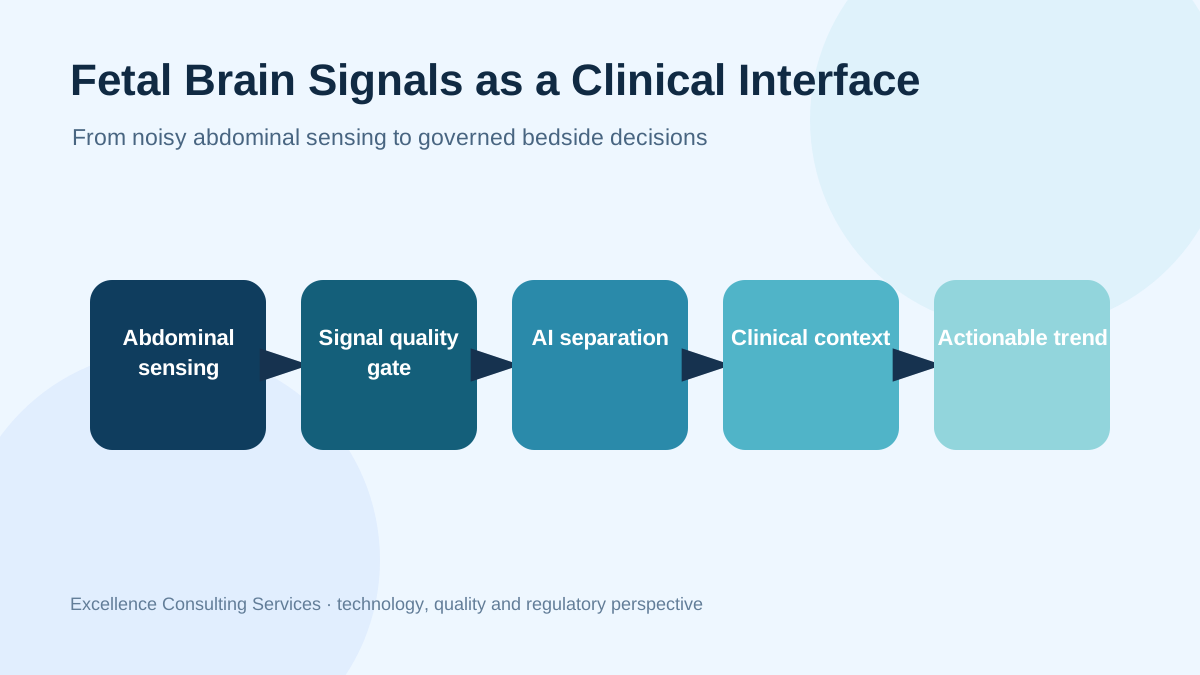
The Quality System Behind Fetal Brain Monitoring
Fetal brain monitoring is often discussed as an AI signal-processing challenge. That is true, but incomplete. The harder question is whether the organisation can build a quality system strong enough to make the signal trustworthy across hospitals, operators, patients and clinical situations. A clever model can perform well in a development dataset and still fail as a medical technology if the surrounding system is weak.
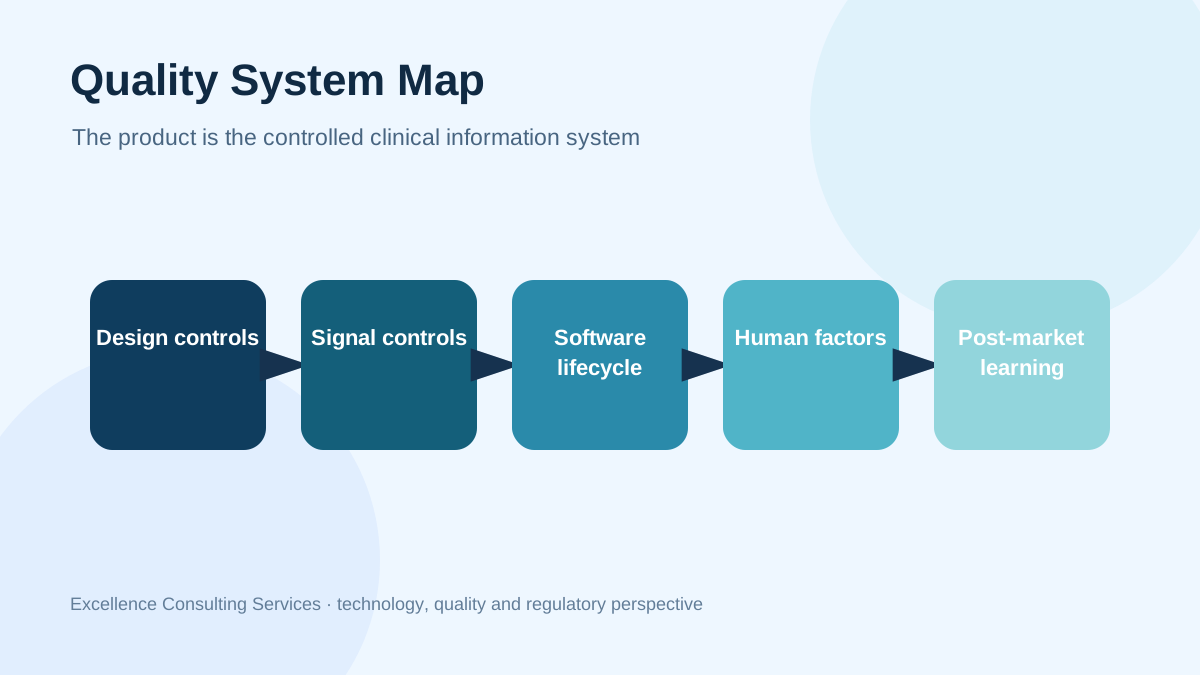
The quality system must connect four domains that are sometimes managed separately: sensor and hardware controls, software and AI lifecycle controls, clinical workflow controls, and evidence controls. If one of these domains is immature, the whole product becomes fragile. A labour ward is not a clean research lab. It is a high-pressure environment where staff rotate, patients move, sensors loosen, emergencies interrupt workflows and documentation must survive medico-legal scrutiny.
Design controls must start with the decision
The first quality question is not “can we measure fetal neural activity?” It is “which clinical decision will be improved, in which population, under which conditions, with which residual risk?” This formulation forces discipline. A system intended to support escalation during labour has different requirements from a research tool, a neonatal monitoring adjunct or a retrospective analytics platform.
User needs should be concrete: reduce uncertainty in selected fetal status assessments, support earlier senior review, improve documentation of neurological trend information, or help distinguish signal loss from physiological change. Each user need should trace to design inputs, verification tests, validation evidence and risk controls. Without this traceability, claims expand faster than evidence.
Signal quality is a design input, not a footnote
For weak physiological signals, quality starts before the model. Electrode placement, impedance, skin preparation, sensor contact, maternal movement and environmental interference must be specified, tested and trained. The system should record signal-quality metadata because future investigations will ask not only what the algorithm predicted, but whether the input was fit for interpretation.
Quality teams should define acceptance criteria for acquisition windows, artefact burden, missing data, latency and recovery after signal loss. These criteria should be visible in verification plans and in the clinical user interface. A hidden signal-quality score that only engineers understand is not sufficient. The clinical team needs operational feedback at the bedside.
Software lifecycle and AI change control
An AI-enabled monitoring system needs disciplined software lifecycle management. Requirements, architecture, unit and integration tests, cybersecurity controls, data pipelines, model-training records, validation datasets, release notes and rollback plans should be maintained as one system. The model is not exempt from configuration management. Training data, labelling rules, preprocessing, feature selection, model weights and thresholds are design outputs.
Change control is especially important. If the model improves after more clinical data are collected, the organisation must decide whether the change is a bug fix, a performance improvement, a new intended use, or a significant change requiring regulatory interaction. The quality system should answer this before commercial pressure appears.
Usability is a primary risk control
In a fetal monitoring context, the user interface is not decoration. It is a risk control. The display must avoid ambiguous colours, overloaded alarms and overconfident language. It should show uncertainty, signal status and trend information in a way that supports team communication. A junior midwife, an obstetrician and an anaesthetist may all see the information under stress; the design must survive that reality.
Human factors validation should include realistic scenarios: poor signal contact, simultaneous maternal movement, emergency transfer, disagreement between heart-rate trace and neural trend, and handover between staff. These are not exotic scenarios. They are exactly where a new signal could help or harm.
Post-market learning should be designed from day one
The category will only mature if post-market data are structured. Complaint handling should distinguish sensor problems, user training problems, software anomalies, clinical interpretation issues and adverse outcomes. Post-market clinical follow-up should monitor performance across gestational age, maternal body habitus, labour stage, comorbidities and site practices. Cybersecurity monitoring and data-integrity controls also matter because clinical confidence depends on trustworthy records.
The executive lesson is straightforward: do not treat the AI model as the solution. The solution is a controlled clinical information system. Its quality depends on acquisition discipline, software lifecycle discipline, usability discipline and evidence discipline working together.
