AI as Both Sword and Shield: The Dual Nature of Artificial Intelligence in Cybersecurity
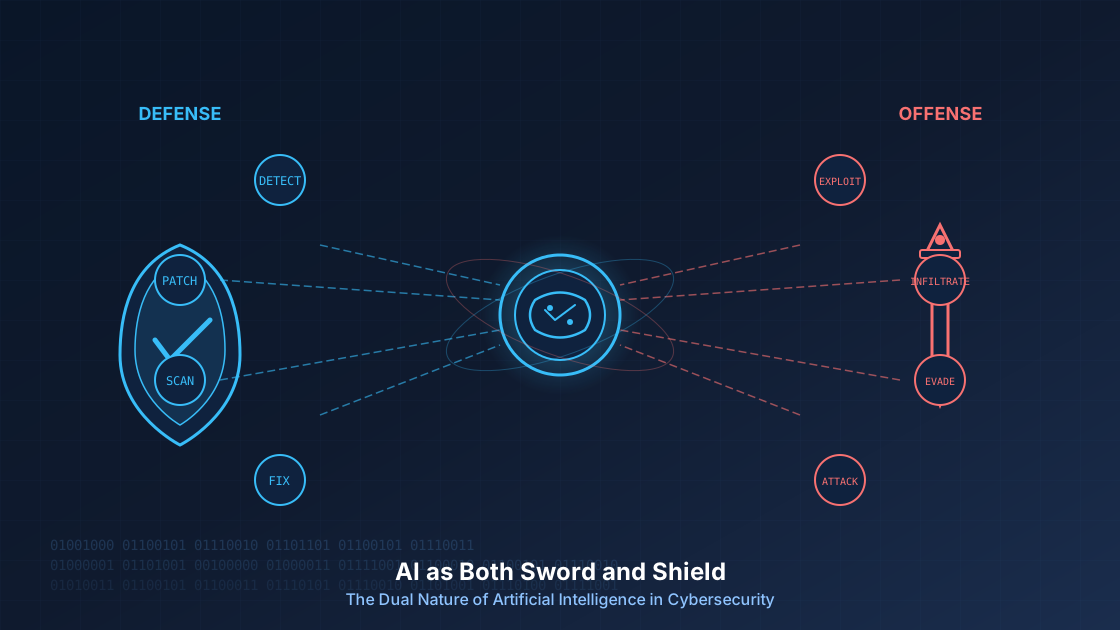
The cybersecurity landscape is witnessing a fundamental shift. For the first time, threat actors are deploying zero-day exploits believed to have been developed with artificial intelligence. This is not a future scenario from a science fiction novel. This is the reality documented by Google Threat Intelligence Group in their May 2026 report. The same technology that powers autonomous malware like PROMPTSPY also drives defensive tools like Big Sleep and CodeMender. AI has become both sword and shield in the ongoing cyber conflict.
The AI-Augmented Threat Landscape
Google Threat Intelligence Group has identified a troubling maturation in adversarial operations. What began as nascent experimentation with AI-enabled tools has evolved into industrial-scale application of generative models within attack workflows. The implications are significant for organizations of all sizes.
Zero-Day Exploits Generated by AI
Perhaps most alarming is the confirmed use of AI in developing zero-day vulnerabilities. GTIG identified a threat actor using a zero-day exploit that analysts believe was developed with AI assistance. The criminal actor planned mass exploitation, but proactive counter-discovery may have prevented widespread damage. This represents a watershed moment. Vulnerability discovery and exploit generation, once requiring deep technical expertise and considerable time, can now be accelerated through AI augmentation.
State-sponsored actors have demonstrated significant interest as well. Threat actors linked to the People's Republic of China and the Democratic People's Republic of Korea are actively exploring AI for vulnerability discovery. The democratization of advanced cyber capabilities is no longer theoretical.
Autonomous Malware Operations
The emergence of AI-enabled malware like PROMPTSPY signals a shift toward autonomous attack orchestration. Unlike traditional malware that executes predetermined routines, these systems interpret system states and dynamically generate commands to manipulate victim environments. Analysis reveals previously unreported capabilities where AI integration allows threat actors to offload operational tasks for scaled and adaptive activity.
This autonomy changes the defender's calculus. Static detection signatures become less effective when malware can modify its behavior in real-time based on environmental feedback.
AI-Augmented Development for Defense Evasion
AI-driven coding has accelerated the development of infrastructure suites and polymorphic malware. These AI-enabled development cycles facilitate defense evasion through the creation of sophisticated obfuscation networks. GTIG has linked AI-generated decoy logic in malware to suspected Russia-nexus threat actors.
The speed of this development is unprecedented. What once required weeks of manual coding can now be generated, tested, and refined in hours. The defensive gap widens when adversaries can iterate faster than defenders can analyze.
Supply Chain Attacks Targeting AI Infrastructure
Adversaries like "TeamPCP" have begun targeting AI environments and software dependencies as initial access vectors. These supply chain attacks create machine learning-focused risks outlined in the Secure AI Framework taxonomy, specifically Insecure Integrated Components and Rogue Actions. Forensic analysis reveals attempts to pivot from compromised AI software to broader network environments for ransomware deployment and extortion.
The Defensive Application of AI
While the threat picture is sobering, the same technologies empowering adversaries also enable powerful defensive capabilities. Google's development of Big Sleep and CodeMender demonstrates that AI can be a formidable tool for defenders when properly applied.
AI Agents for Vulnerability Discovery
Big Sleep represents a paradigm shift in proactive security. Rather than waiting for attackers to discover vulnerabilities, AI agents can continuously scan codebases to identify weaknesses before exploitation. This flips the traditional security model from reactive to predictive.
Automated Remediation
CodeMender extends this capability by automatically fixing identified vulnerabilities. The reasoning capabilities of large language models enable not just detection but remediation at scale. This addresses the persistent challenge of patch management where organizations often struggle to deploy fixes faster than attackers can exploit known vulnerabilities.
Enhanced Threat Detection
AI-augmented analysis of network traffic and system behavior enables detection of novel attack patterns that signature-based systems miss. The ability to process vast amounts of telemetry and identify anomalous patterns in real-time provides defenders with critical visibility.
Strategic Implications for Security Leaders
The dual-use nature of AI in cybersecurity creates both risks and opportunities. Security leaders must navigate this landscape with clear-eyed assessment of capabilities and limitations.
Understanding the Asymmetry
Attackers benefit from asymmetry in the AI security equation. A single successful AI-generated exploit can compromise thousands of systems. Defenders must protect everything while attackers need only find one weakness. This fundamental asymmetry is amplified by AI's ability to scale reconnaissance and exploitation.
Investment in AI-Enabled Defense
Organizations must accelerate investment in AI-enabled defensive capabilities. Traditional security operations centers struggle to process the volume of alerts generated by modern enterprises. AI-augmented triage and analysis become force multipliers for finite security teams.
Proactive Security Posture
The shift from reactive to proactive security is no longer optional. Continuous vulnerability assessment, automated patching where possible, and AI-assisted threat hunting become baseline capabilities. Organizations that wait for attacks before responding face insurmountable disadvantages.
The Path Forward
AI's role in cybersecurity will only expand. The technology is too powerful and too accessible for adversaries to ignore. Yet the same accessibility benefits defenders. Open-source frameworks, commercial solutions, and cloud-based capabilities democratize advanced security tools previously available only to well-resourced organizations.
The key is balanced investment. Security programs must simultaneously address traditional fundamentals while embracing AI-augmented capabilities. Organizations that neglect either dimension create exploitable gaps.
Conclusion
AI has become both sword and shield in cybersecurity. The Google Threat Intelligence Group findings demonstrate that adversaries are already leveraging AI for vulnerability discovery, autonomous malware, and defense evasion. Yet the same technology enables unprecedented defensive capabilities through automated vulnerability discovery, intelligent remediation, and enhanced threat detection.
Security leaders must acknowledge this duality. The organizations that thrive will be those that embrace AI's defensive potential while maintaining vigilance against its offensive application. The cyber battlefield has evolved. Our strategies must evolve with it.
The question is no longer whether AI will transform cybersecurity. It already has. The question is whether your organization will leverage AI as effectively as your adversaries.
