Quiet Leadership: Why the Most Effective Leaders Are Not the Loudest in the Room
Leadership is often mistaken for performance. Many executives are encouraged to speak first, speak often, and make sure the room feels their energy. That can help at times, but the people who move organizations forward are usually the ones who reduce confusion, create trust, and make good decisions repeatable.
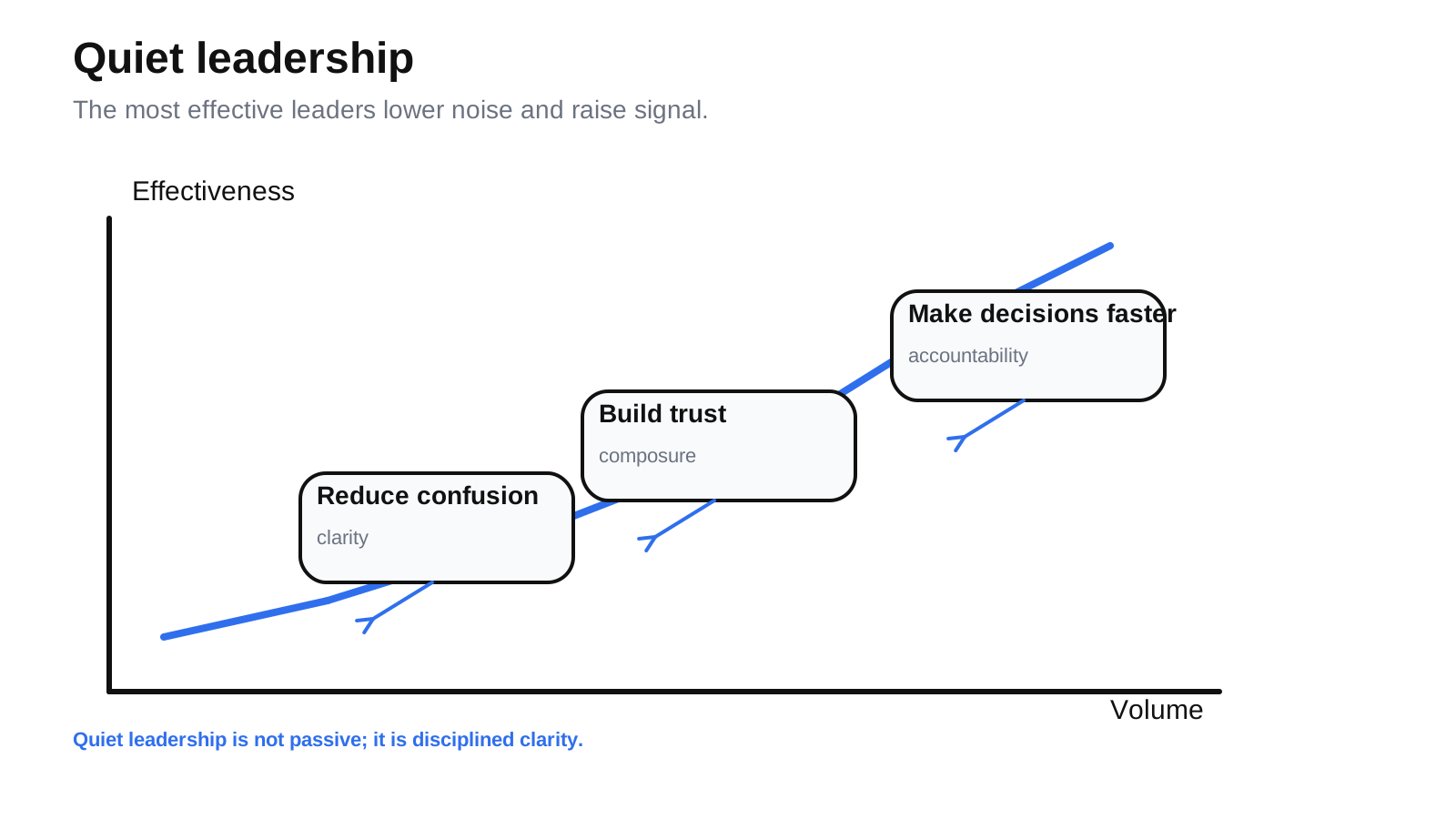
Quiet leadership is not passivity. It is not a lack of conviction, and it is not a refusal to be visible. It is the discipline of using attention with purpose. Quiet leaders do not chase volume; they focus on clarity. They do not use force to appear strong; they create conditions in which other people can do their best work.
What quiet leadership looks like in practice
In a board meeting, a loud leader may fill the room with opinions. A quiet leader asks one or two precise questions, waits for the evidence, and then frames the decision in plain language. In a turnaround, a loud leader may announce urgency every day. A quiet leader sets a short list of priorities, aligns ownership, and checks progress against real outcomes.
In a cross-functional conflict, quiet leadership sounds like this: What is the actual trade-off? What evidence do we have? What decision would we still defend in six months? That approach lowers emotional temperature without lowering standards.
- Clarity: define the outcome, the constraints, and the non-negotiables.
- Composure: stay calm long enough for the team to think.
- Consistency: make your principles visible in repeated decisions, not slogans.
- Accountability: assign ownership and follow through.
Why executives should care
Executives do not get rewarded for sounding impressive in isolation. They get rewarded for aligning people around priorities and keeping the organization moving. Quiet leadership helps because it shortens the path from confusion to decision. It reduces the performance theater that often slows teams down.
Consider an acquisition integration. The loudest leader may try to solve every issue personally. The effective leader sets a few principles, names the owners, and uses a small cadence of check-ins to remove blockers. The result is usually less drama and more execution.
Or consider a product review. One executive may talk for twenty minutes about what the team should build. A quieter leader will ask what problem the customer is actually facing, what evidence changed since last week, and what decision the team needs from leadership. The team leaves with direction instead of just noise.
Where quiet leadership can fail
Quiet leadership has limits. If it becomes vague, silence is read as uncertainty. If it becomes passive, politics and assumptions fill the vacuum. If it becomes too private, the organization may not know what matters or why.
It can also be misread in environments that equate confidence with visible intensity. That is why quiet leaders still need to speak up publicly when the stakes require it.
There are moments when a more directive style is appropriate: a safety incident, a severe customer outage, a reputational crisis, or a legal exposure that demands fast coordination. Quiet leadership does not mean flat affect in a fire. It means using the right level of energy for the problem.
A practical operating model for leaders
- Start meetings with the decision, not with a speech.
- Ask one question before offering your opinion.
- Separate facts, assumptions, and preferences.
- End every important discussion with an owner, a deadline, and a success measure.
- Communicate priorities in writing so the message survives the meeting.
- Measure trust, decision speed, and execution quality, not decibels.
The most useful question for an executive is not, Did I sound energetic? It is, Did I make the next step clearer, faster, and more reliable? That is where quiet leadership earns its place.
Takeaways
- Quiet leadership is active, not passive.
- Its job is to lower noise and raise signal.
- It works best when paired with visible accountability.
- It is strongest when the leader can be calm without becoming unclear.
In the end, the most effective leaders are not the loudest in the room. They are the ones people can trust when the room gets noisy, the stakes get high, and the organization needs more clarity than volume.
