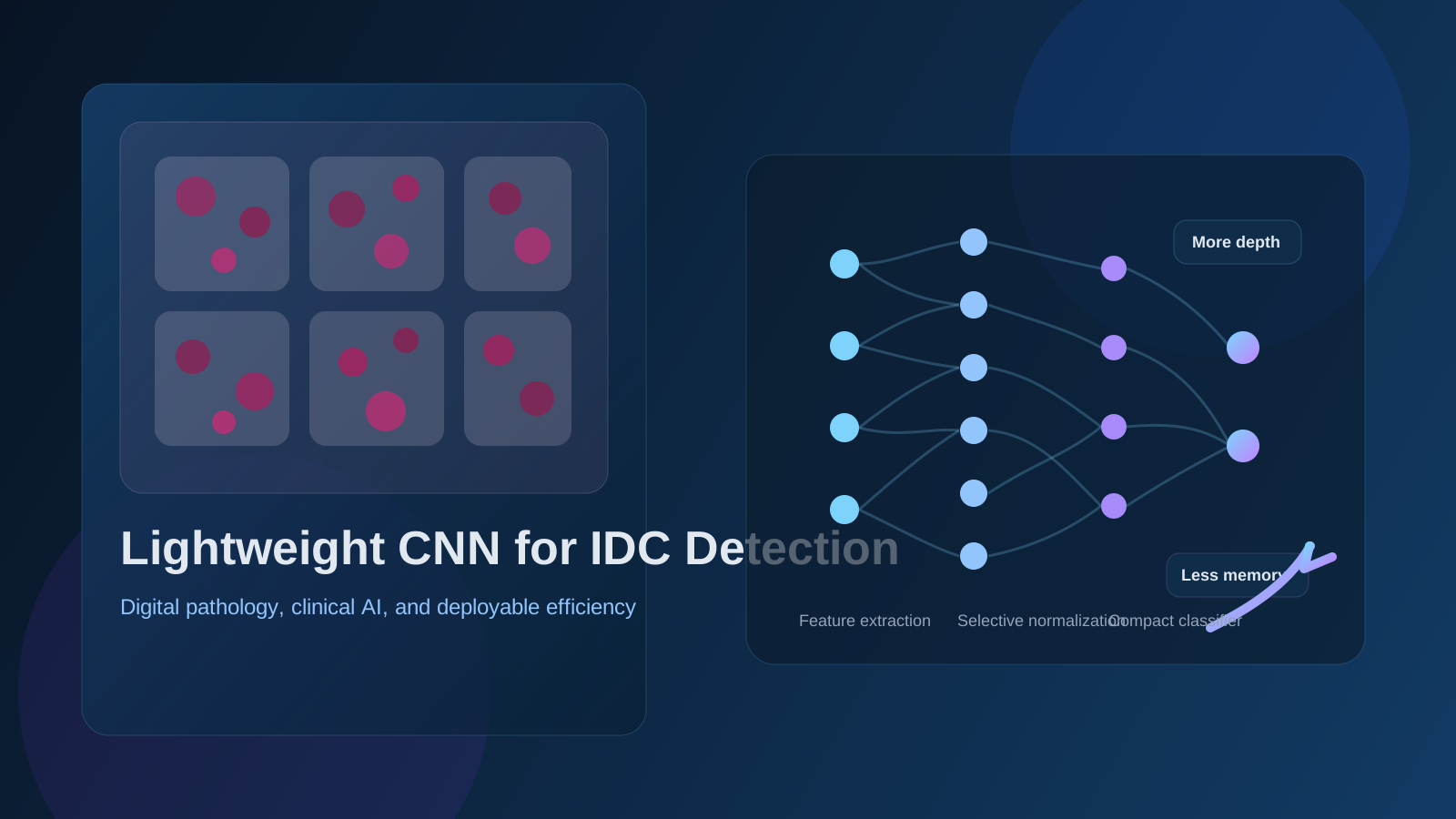
A Technical Review of a Lightweight CNN for Invasive Ductal Carcinoma Detection
Digital pathology teams often face a frustrating tradeoff. The models with the best published accuracy are usually the hardest to operationalize, while the models that fit ordinary clinical infrastructure often lose too much performance to be trusted. A recent study on invasive ductal carcinoma, the most common histological subtype of breast cancer, is interesting because it tries to break that pattern.
Inspired by this article. The analysis below is original and written for clinical, AI/ML, and hospital leadership audiences.
The paper presents an updated CNN architecture for histopathology patch classification that reportedly improves accuracy and recall while reducing GPU memory usage by roughly 80 percent compared with its predecessor. If that result holds in broader validation, it matters for three different reasons. Clinicians get a more deployable second-reader capability, AI teams get a better efficiency-performance profile, and hospital executives get a stronger argument that pathology AI can move closer to routine infrastructure instead of staying trapped in research environments.
Why this problem is operationally important
Invasive ductal carcinoma diagnosis still depends on histopathological examination by trained specialists. That workflow is accurate, but it is also capacity-constrained and variable in turnaround time. In many hospitals, the strategic value of AI in pathology is not to replace the pathologist. It is to triage, prioritize, flag suspicious regions, and reduce the cognitive burden in high-volume workflows.
The challenge is that histopathology is not a natural-image problem. These image patches are dense, repetitive, texture-heavy, and dominated by a narrow stain distribution. That means architectures borrowed directly from conventional computer vision often carry unnecessary computational cost or fail to capture the most relevant tissue-specific structure. A domain-tuned model therefore matters more than another generic "lightweight" network ported from natural image benchmarks.
The architectural contribution in plain technical terms
The authors build on an earlier architecture, BCDNet, and introduce six coordinated changes rather than one dramatic redesign. This is a technically sensible move. In real medical AI engineering, small architecture decisions often interact strongly, especially when trying to improve both discrimination and efficiency at the same time.
- More depth: The network increases from four convolutional processing stages to six. This gives the model a richer hierarchy for learning tissue morphology, from low-level stain and edge patterns to higher-level glandular and nuclear arrangements.
- Leaky activation instead of hard zeroing: Replacing a strict ReLU-style cutoff with a leaky variant helps preserve gradient flow in deeper layers, reducing the chance that a portion of the network becomes inactive and stops learning.
- Selective batch normalization: Instead of applying normalization after every layer, the design places it in the deeper part of the network where internal representation drift is more likely to destabilize training. That reduces overhead while preserving most of the stabilization benefit.
- Progressive dropout: The model applies lighter regularization in early layers and stronger regularization in later layers. That matches where overfitting risk typically becomes more pronounced, especially when deeper features start encoding dataset-specific patterns.
- Global average pooling: This is one of the most important efficiency changes. Rather than flattening the full feature map into a very large dense classifier, the network averages each learned feature map into a compact summary statistic.
- A smaller classifier head: After global average pooling, the model uses a lighter fully connected decision stage. This sharply reduces parameter count and with it both memory demand and deployment friction.
From an ML systems perspective, this is not just a list of tweaks. It is a coherent redesign that moves compute away from a parameter-heavy classifier tail and toward more useful representational learning in the convolutional body.
Why global average pooling matters more than it first appears
Many non-technical summaries will focus on the memory reduction number, but the more interesting technical point is where that reduction comes from. Flattening a deep feature tensor into large dense layers is often the least elegant part of older CNN classifiers. It introduces a large parameter burden and can make the model more brittle, especially when feature location shifts within the patch.
Global average pooling changes that. It compresses each channel into a single summary value, preserving feature presence while reducing sensitivity to exact spatial placement. For histopathology, where malignant regions can appear in different locations within a tile, this can be a very useful inductive bias. It also substantially lowers the cost of training and inference. For hospital IT leaders, this is where the paper becomes practical, because memory efficiency is not only a research metric. It affects whether a model can be piloted on available infrastructure.
Reported gains and what they imply
According to the study, the redesigned model outperformed the baseline across key classification metrics while using far less GPU memory and without increasing training time. That is the profile every pathology AI team wants to see. Better sensitivity is clinically valuable. Lower memory demand is operationally valuable. No additional training-time penalty is strategically valuable because it improves iteration speed.
If these findings generalize, the work suggests an important principle for hospital AI programs: performance improvement does not always require larger models or more hardware. In some cases, the better path is architecture specialization, where the model is redesigned around the morphology and deployment constraints of the actual domain.
What clinical experts should still be cautious about
The study should still be treated as proof of concept, not procurement-grade evidence. The current evaluation, based on the available summary, appears limited to a single dataset with no repeated-run robustness analysis, no external cohort validation, and no cross-site testing. That means the usual clinical concerns remain open: stain variation, scanner variation, site-specific bias, and generalization beyond the original data source.
There is also no strong indication of explainability work, such as saliency review, error stratification, or pathologist confirmation that the network is attending to diagnostically meaningful structures rather than confounded texture shortcuts. In pathology AI, this is not a cosmetic add-on. It is essential for trust-building and for identifying failure modes before deployment.
What AI and ML teams should validate next
- External validation: Test the architecture across multiple institutions, scanners, staining protocols, and class balances.
- Reproducibility: Report repeated training runs with variance, confidence intervals, and sensitivity to initialization.
- Explainability and failure analysis: Review false positives and false negatives with pathologists, not only with aggregate metrics.
- Workflow fit: Measure whether the model improves triage speed, review consistency, or case prioritization in a realistic pathology workflow.
- MLOps readiness: Plan for versioning, monitoring, revalidation, and drift detection before considering live use.
What hospital CEOs and decision-makers should take from this
The real message for hospital leadership is not "buy this model." It is that efficient medical AI is becoming more plausible when architecture choices are aligned with clinical use cases and infrastructure reality. That changes the investment conversation. Instead of asking only whether a model achieves state-of-the-art numbers, hospitals should ask whether it can be validated, integrated, governed, and supported within the operating environment they actually have.
A model that needs exceptional hardware, extensive tuning, and research-grade support may still be impressive, but it is not automatically strategic. A model that is slightly more modest in complexity and substantially easier to operationalize may deliver more real value. This paper is interesting because it points toward that second category.
Conclusion
This study is a useful reminder that in clinical AI, elegance often comes from smarter architecture rather than larger scale. By combining deeper feature learning, better gradient behavior, targeted regularization, and a far leaner classification stage, the authors appear to have moved the efficiency-performance frontier in the right direction for breast histopathology.
For now, it remains an early-stage result that needs stronger validation. But as a direction of travel, it is exactly the kind of work hospitals, clinical AI teams, and digital pathology programs should be watching closely.
