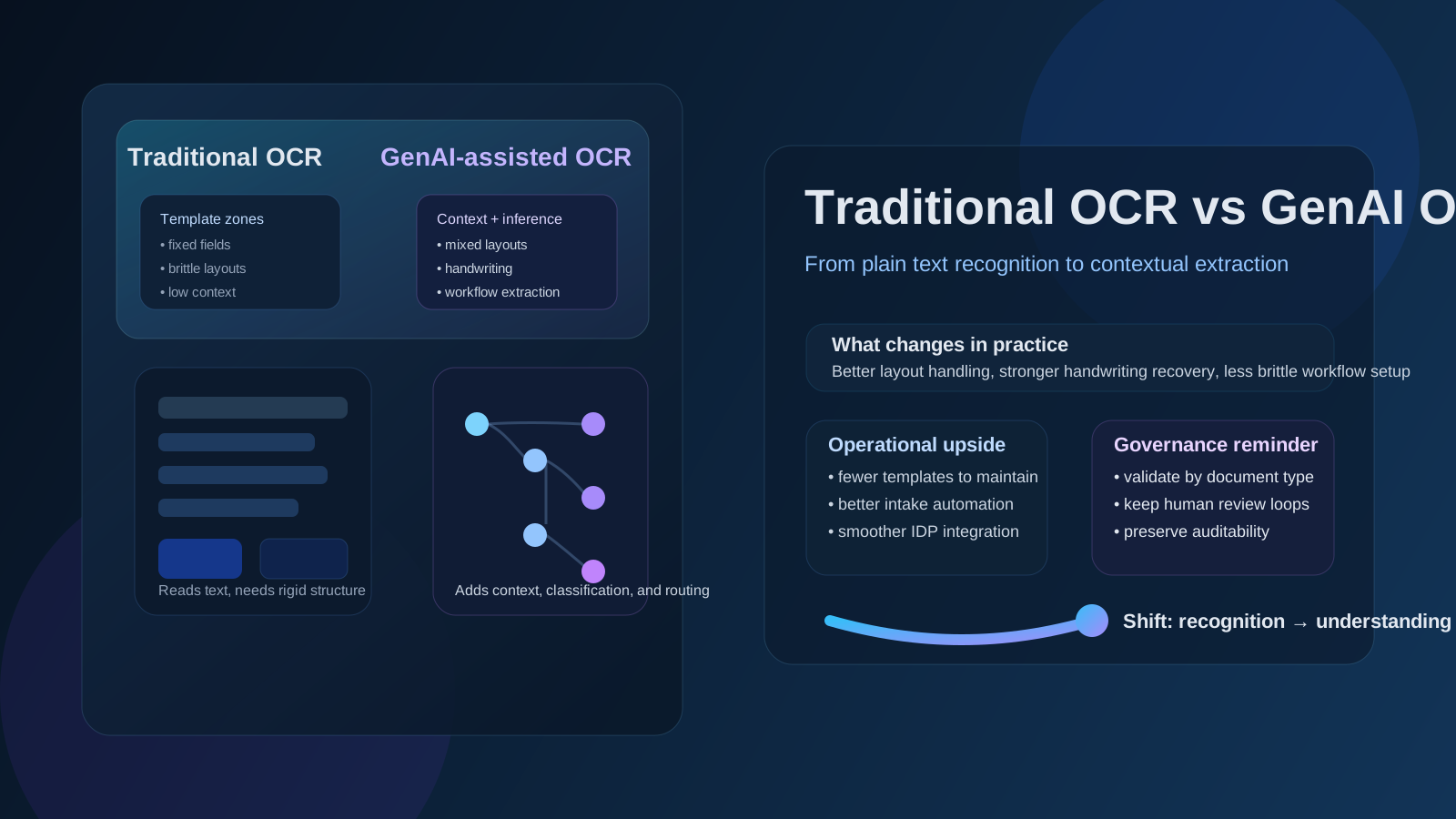
Traditional OCR vs Generative AI-Assisted OCR: What Changes for Healthcare Operations?
Traditional OCR helped organizations digitize paper, but in most real operating environments that was only the beginning. The harder problem was always interpretation. A scanned invoice, referral letter, consent form, pathology note, discharge summary, or handwritten instruction is only useful when the system can identify what matters, place it in context, and route it into the correct workflow with acceptable accuracy.
Inspired by Dhavalkumar Patel, Comparing Traditional OCR with Generative AI-Assisted OCR: Advancements and Applications, International Journal of Science and Research (IJSR), Volume 14 Issue 6, June 2025. The analysis below is original and written for healthcare, AI/ML, and executive audiences.
A recent comparative review by Dhavalkumar Patel captures a shift many hospitals and document-heavy organizations are now seeing directly. The future of document automation is no longer only about character recognition. It is about contextual extraction, adaptability, and workflow readiness. That is the difference between an OCR tool that creates raw text and a document-processing capability that can actually support operations.
Why this matters now
Traditional OCR was designed for a more stable document world. It performs reasonably well when documents are structured, layouts are predictable, and image quality is good. That is why it has long been useful for books, standardized forms, invoices, and fixed-layout records.
But real enterprise workflows are rarely that clean. Hospitals deal with mixed document types, low-quality scans, handwritten annotations, multi-page referrals, legacy PDFs, multilingual content, and records that were never designed for machine readability. The same is true in finance, insurance, logistics, and regulated operations more broadly. In those settings, the bottleneck is not only reading text. It is extracting meaning from inconsistent inputs without building brittle template logic for every variation.
Where traditional OCR still works well
Traditional OCR remains useful when the task is stable and narrow. It still performs well enough when:
- layouts are fixed and repetitive
- document classes are narrow and well understood
- handwriting is rare or excluded
- image quality is controlled
- the task is simple transcription rather than interpretation
If an organization processes a stable invoice template from a small number of suppliers, or digitizes printed archival text with clean scans, conventional OCR can still be efficient and cost-effective. Not every workflow needs a generative AI layer, and many teams waste time by replacing a good deterministic system with something more complex than the use case requires.
Where traditional OCR breaks down
The review’s assessment of traditional OCR’s weaknesses is familiar to anyone who has implemented document workflows at scale. Traditional systems usually depend on predefined rules, zones, or templates. That makes them fragile when page structure, font style, field position, language, script, image quality, or handwriting changes.
More importantly, traditional OCR does not understand context. It can extract numbers and words, but it often cannot reliably determine what those numbers and words mean in the business or clinical setting. In a hospital workflow, it is not enough to detect text on a page. The system may need to distinguish diagnosis from recommendation, dosage from frequency, historical problem list from current condition, or patient identifier from accession number. Once the workflow depends on interpretation rather than transcription, the limits of traditional OCR become expensive.
What generative AI-assisted OCR adds
The paper argues that generative AI-assisted OCR changes the architecture of the problem. Instead of relying mainly on static pattern matching, AI-assisted OCR uses neural networks, deep learning, and transformer-based models to process the document more holistically. That creates several practical advantages.
- Better handling of unstructured documents: Generative AI-assisted OCR is far more capable when layouts are inconsistent. It can work across referral letters, clinical summaries, handwritten notes, tables, forms with shifted fields, and mixed-format business documents without requiring a full template redesign each time.
- Contextual understanding: The model is no longer only identifying characters. It uses surrounding textual and visual context to infer what a field or passage means. That can materially improve extraction quality when documents are ambiguous, partially degraded, or semantically dense.
- Better handwriting and poor-image performance: Traditional OCR often fails on low-resolution scans, blur, skew, faint print, and variable handwriting. AI-assisted OCR can use contextual inference and stronger image preprocessing to recover useful output where older approaches deteriorate quickly.
- Faster adaptation to new document types: Few-shot and zero-shot style behavior matters operationally because the system can adapt to new document types with much less configuration effort than a purely rule-based setup.
- Closer integration with intelligent document processing: AI-assisted OCR fits more naturally into end-to-end workflows that also include classification, validation, routing, summarization, and downstream system integration.
The healthcare angle is especially important
Although the paper is broad, its implications are especially strong for healthcare systems. Healthcare organizations are saturated with semi-structured and unstructured documents. Even highly digital environments still depend on PDFs, scanned referrals, handwritten forms, pathology attachments, insurer communications, outside records, and consent documentation. That creates persistent friction in care coordination, revenue cycle operations, clinical administration, and quality workflows.
Generative AI-assisted OCR could help in areas such as referral intake and triage, prior authorization handling, claims and billing support, extraction from scanned lab and pathology reports, digitization of legacy records, multilingual administrative documents, and operational processing of handwritten or annotated forms. But better OCR is not the same as safe automation. Once OCR outputs start driving decisions, the governance bar rises sharply.
What AI and ML teams should validate next
The paper is directionally useful, but it should not be mistaken for decisive production evidence. It is primarily a comparative review, not a rigorous head-to-head benchmark under tightly controlled real-world deployment conditions. Technical teams should treat it as a framing document, then validate the claims locally.
- Error profiling: Measure performance by document type, not only as a global average.
- Stress testing: Test low-quality scans, multilingual inputs, and handwritten content explicitly.
- Separation of extraction and interpretation: Understand where the system is reading source content versus inferring likely structure or meaning.
- Human review design: Define review loops for safety-critical or compliance-relevant fields before deployment.
- Drift monitoring: Plan for evolving layouts and changing document sources over time.
- Auditability: Ensure the workflow keeps a traceable link back to source evidence rather than treating generated output as self-justifying.
The last point matters more than many teams expect. Generative systems are powerful precisely because they infer structure and meaning. But in regulated settings, inferred content must be governed carefully. A system that helpfully reconstructs a field is not automatically acceptable if the workflow requires source-grounded extraction.
What hospital CEOs and operational leaders should take from this
The business case is not simply that GenAI is better than OCR. The stronger conclusion is that document processing is shifting from a narrow automation problem to a systems design problem. The question is no longer only whether a tool can read text. The question is whether the organization can build a reliable document-processing pipeline that balances extraction accuracy, contextual interpretation, exception handling, human review, auditability, integration, security, and compliance.
If an organization keeps adding manual review teams to compensate for brittle OCR, its automation savings are often overstated. If it deploys generative AI-assisted OCR without clear governance, it may create new compliance and operational risks. The winning strategy is usually neither nostalgia for legacy OCR nor blind enthusiasm for GenAI. It is disciplined workflow design.
Conclusion
Patel’s review does not prove that every organization should replace traditional OCR immediately. What it does show is that the technical center of gravity has shifted. Traditional OCR is best understood today as a mature but limited technology for predictable document environments. Generative AI-assisted OCR is better suited to the variability, ambiguity, and contextual demands of modern workflows, especially in healthcare and other document-intensive sectors.
For leaders, the takeaway is simple. Do not evaluate OCR as a standalone tool anymore. Evaluate it as part of an intelligent document processing strategy, with equal attention to performance, workflow design, and control. That is where the real value now sits.
