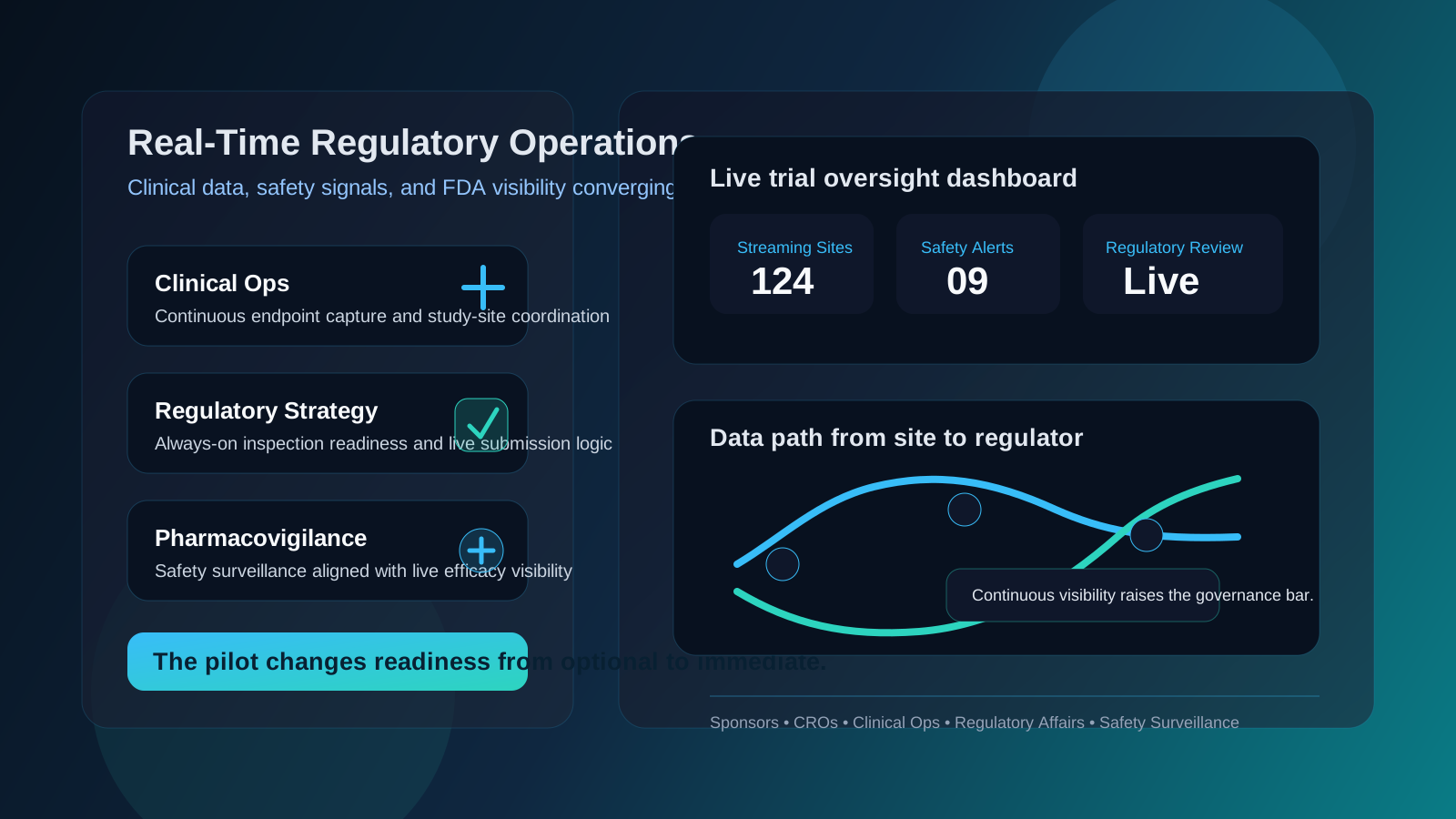
FDA’s Elsa 4.0 and HALO Signal a Bigger Shift in Regulatory Operations
The FDA’s latest announcement looks, at first glance, like a straightforward technology update. The agency launched Elsa 4.0, an upgraded internal AI tool for FDA staff, and completed consolidation of more than 40 application, submission, and portal systems into a new platform called HALO — Harmonized AI & Lifecycle Operations for Data.
That is interesting. But the more important story is not the feature list. It is the operating model underneath it.
The FDA is not just adding more AI capabilities to an internal assistant. It is building the data infrastructure that could make AI-native regulatory operations practical at agency scale.
The strategic signal here is simple: the FDA appears to understand that AI transformation is not mainly about chat interfaces. It is about connecting AI to secure, structured, workflow-level data.
What the FDA actually announced
According to the agency, Elsa 4.0 is now available across the FDA, from scientific reviewers to investigators. New features include custom agents, document generation, quantitative analysis and charting, secure web search, voice-to-text dictation, OCR, and improved search across large document repositories.
At the same time, the FDA says it has consolidated more than 40 previously separate systems and portals into HALO, a unified data platform. The agency has also started integrating HALO with Elsa so staff can query data and build workflows without manually uploading documents into each chat session.
That last point matters more than most of the feature bullets. Moving from manual document upload to AI sitting directly on top of operational data is a real architectural shift.
Why HALO may matter more than Elsa 4.0 itself
Many organisations talk about AI transformation as if the model is the hard part. Usually it is not. The hard part is fragmented systems, inconsistent metadata, messy workflows, and data that cannot be trusted or accessed cleanly enough to support real operational use.
That is why I think HALO may prove more consequential than Elsa 4.0.
If the FDA has genuinely created a usable harmonized data layer across centers, then the agency is solving the problem that blocks most enterprise AI programs before they become genuinely useful. In most regulated environments, AI does not fail because the model is too weak. It fails because the data environment is too fragmented, too brittle, or too disconnected from real work.
The FDA seems to be addressing exactly that constraint.
What this means for regulated industry
For medical device, pharmaceutical, and digital health companies, this should not be read as a vague modernization press release. It is a practical signal about how regulatory work may evolve inside the agency.
Three implications stand out.
- Review operations may become more integrated and more data-native. That does not automatically mean dramatically shorter review timelines tomorrow. But it does suggest that the FDA is trying to reduce internal handling friction and allow staff to spend more energy on scientific assessment rather than information hunting.
- Submission quality and structure may matter even more. If agency staff increasingly work through AI-supported retrieval, search, and workflow tools, then submission clarity, consistency, and traceability become even more valuable. Poorly structured content may become more visibly weak inside a more searchable review environment.
- Regulatory intelligence should include operational signals, not just policy signals. Companies often monitor guidance, rulemaking, and speeches. They watch legal requirements. They watch enforcement. They are less good at watching how the agency’s internal operating model is changing. That is a mistake.
The AI governance message is also worth noticing
The FDA says Elsa is built in a FedRAMP High Google Cloud environment, does not train on FDA input data or regulated industry submission data, and keeps human subject matter experts involved in verifying inputs, analytical processes, and output implementation.
That does not answer every governance question, but it does show a fairly mature framing. The agency is not presenting AI as autonomous magic. It is presenting it as a controlled internal capability with security boundaries, non-training safeguards, and human oversight.
Frankly, many private-sector AI programs still speak less precisely than that.
What leaders should do with this signal now
If you lead regulatory affairs, quality, clinical, or product strategy in a regulated company, the lesson is not “the FDA has an AI chatbot now.” The lesson is that the agency may be redesigning the mechanics of regulatory work around AI-connected data systems.
That should push companies to ask a few uncomfortable but useful questions:
- Are our submissions structured in ways that support efficient machine-assisted review and retrieval?
- Do our internal regulatory and quality data environments reflect the same maturity we assume regulators should have?
- Are we treating AI readiness as a model-selection question when the real issue is workflow and data architecture?
These are not abstract questions anymore. They connect directly to how future regulatory operations may actually run.
My view
I think this is one of the more meaningful FDA modernization announcements in recent memory, not because Elsa 4.0 has custom agents or OCR, but because the agency appears to be building the harder layer beneath the interface.
That is the right move.
AI on top of fragmented systems creates demos. AI on top of harmonized operational data creates leverage. If HALO is real in the way the FDA describes it, the agency is moving toward the second model rather than the first.
Conclusion
The FDA’s Elsa 4.0 and HALO announcement should be read as more than an internal tooling upgrade. It points to a deeper shift: regulatory operations are being rebuilt around unified data, workflow integration, and AI-assisted access to institutional knowledge.
For industry, that matters now. Not because the rules changed overnight, but because the machinery behind regulatory work may be changing faster than many companies are preparing for.
The smart response is not hype. It is readiness.
