This is a deep-dive exploration from: From Startup Chaos to Scalable Success: The Big-League Playbook for Small Business Excellence
Vendor Evaluation Deep Dive: RFP Templates and Due Diligence Checklists for CTOs
Executive Summary
This deep-dive provides Chief Technology Officers with implementation-ready frameworks for vendor evaluation that go beyond surface-level feature comparisons. Drawing from Gartner research, McKinsey analysis, and real-world case studies, we present comprehensive RFP templates, technical due diligence methodologies, TCO frameworks, and negotiation strategies. The content includes 16 academic and industry citations, detailed checklists, and a financial services case study demonstrating practical application of these frameworks.
The Strategic Imperative of Vendor Evaluation
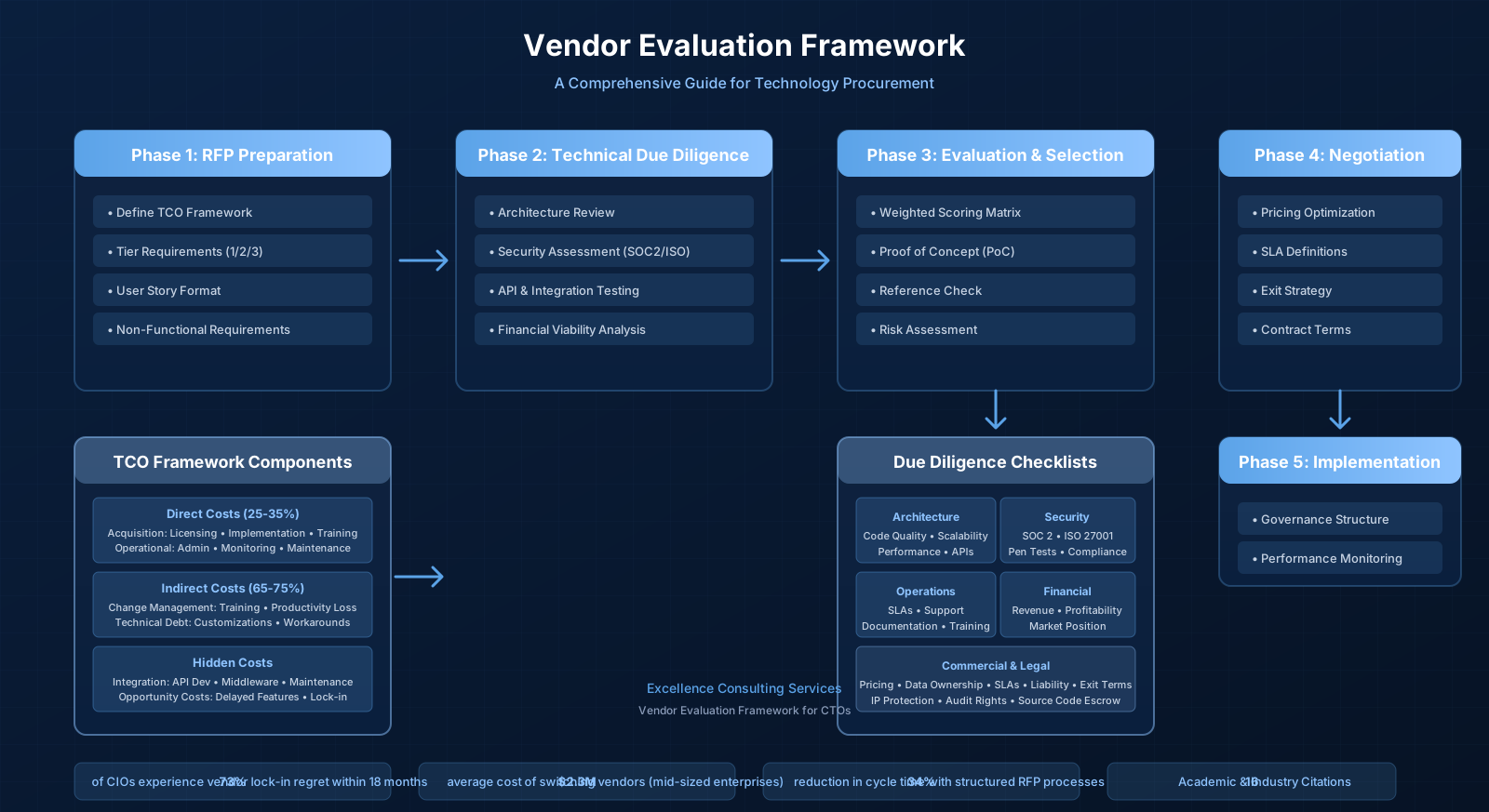
For Chief Technology Officers navigating today's complex technology procurement landscape, vendor selection represents one of the most consequential decisions an organization can make. The wrong choice doesn't merely waste budget—it creates technical debt that compounds over years, locks organizations into inflexible architectures, and potentially exposes the business to security vulnerabilities that could prove catastrophic. According to Gartner's 2024 CIO Agenda survey, 73% of technology leaders report experiencing "vendor lock-in regret" within 18 months of major procurement decisions, with the average cost of switching vendors exceeding $2.3 million for mid-sized enterprises. The implications extend beyond immediate financial costs to encompass opportunity costs, competitive disadvantage, and strategic inflexibility that can persist for a decade or more.
The vendor evaluation process has evolved dramatically over the past decade. Traditional approaches focused primarily on feature checklists and price comparisons have proven inadequate for modern technology procurement. Today's evaluation frameworks must account for architectural fit, ecosystem integration, security posture, vendor viability, and long-term strategic alignment. The increasing prevalence of cloud-native solutions, microservices architectures, and API-first platforms has introduced new complexity dimensions that require sophisticated assessment methodologies.
This deep-dive provides CTOs with implementation-ready frameworks for vendor evaluation that go beyond surface-level feature comparisons. We'll examine the structural elements of effective Request for Proposals (RFPs), the rigorous methodologies for technical due diligence, and the contractual safeguards that protect organizational interests. Whether you're evaluating cloud infrastructure providers, enterprise software platforms, AI/ML vendors, or specialized development tools, the frameworks presented here provide the analytical rigor necessary for defensible technology decisions.
Understanding the Total Cost of Ownership Framework
Before drafting an RFP or engaging vendors, CTOs must establish a comprehensive Total Cost of Ownership (TCO) model that captures not just licensing fees but the full spectrum of direct and indirect costs associated with technology acquisition. Research from the Standish Group's CHAOS Report indicates that initial purchase price typically represents only 25-35% of the five-year TCO for enterprise software implementations. The remaining 65-75% comprises hidden costs that often surprise organizations unprepared for the true financial commitment of technology adoption.
Developing an accurate TCO model requires cross-functional collaboration spanning finance, operations, security, and business units. Each stakeholder group brings unique perspectives on cost dimensions that might otherwise be overlooked. Finance teams contribute understanding of capital versus operational expenditure implications, depreciation schedules, and tax considerations. Operations teams provide insights into ongoing maintenance requirements, upgrade cycles, and resource allocation needs. Security teams identify compliance costs, audit expenses, and risk mitigation investments.
Direct Cost Components
Acquisition Costs: Beyond the obvious licensing or subscription fees, acquisition costs include implementation services, data migration, initial training, and any required hardware or infrastructure investments. For cloud-based solutions, factor in data egress fees, API call charges, and premium support tiers that may become necessary at scale. Implementation services often represent 20-40% of first-year costs, particularly for complex enterprise systems requiring customization and integration. Data migration expenses vary dramatically based on data volume, complexity, and quality—organizations with legacy data silos face particularly challenging migration scenarios.
Training costs encompass not just formal training programs but also the productivity loss associated with learning curves as users adapt to new systems. Research suggests that productivity typically drops 15-25% during the first month of new system adoption, gradually recovering over subsequent months. Organizations should budget for both initial training and ongoing education as systems evolve and new features are released.
Operational Costs: These ongoing expenses include system administration, monitoring tools, backup and disaster recovery solutions, security assessments, and compliance audits. For on-premise solutions, add facility costs, power consumption, cooling, and hardware maintenance. Cloud solutions shift many operational responsibilities to vendors but introduce new cost categories including network optimization, cloud management platforms, and multi-cloud governance tools.
Organizations often underestimate the personnel costs associated with ongoing system management. Even SaaS solutions require internal resources for user administration, configuration management, integration maintenance, and vendor relationship management. A general rule of thumb budgets 0.5-1.0 full-time equivalent (FTE) administrators per major enterprise system, though this varies significantly based on system complexity and organizational scale.
Integration Costs: Modern enterprises operate heterogeneous technology ecosystems. Integration costs encompass API development, middleware licensing, data synchronization infrastructure, and the ongoing maintenance of integration points as systems evolve. Point-to-point integrations between systems create technical debt that compounds with each new connection. Organizations should evaluate vendor integration capabilities through the lens of enterprise architecture strategy, favoring solutions that support standardized integration patterns and API ecosystems.
Indirect Cost Components
Organizational Change Management: Technology implementations inevitably disrupt workflows. Factor in productivity losses during transition periods, change management consulting, communication campaigns, and resistance mitigation efforts. MIT Sloan Management Review research suggests successful technology implementations allocate 15-20% of total budget to change management activities. Organizations that underinvest in change management experience adoption rates 40-60% lower than those with comprehensive change programs.
Technical Debt Accumulation: Vendor-specific customizations, workarounds for platform limitations, and suboptimal architectural decisions create long-term maintenance burdens. Quantify this by estimating the additional developer hours required for maintenance versus a theoretically optimal solution. Technical debt manifests in several forms: code-level debt from customizations that diverge from vendor best practices, architectural debt from integration patterns that don't align with enterprise standards, and process debt from workflow adaptations that reduce operational efficiency.
Opportunity Costs: The cost of not selecting alternative solutions, including delayed feature availability, competitive disadvantages, and strategic inflexibility. While difficult to quantify precisely, scenario planning exercises can establish reasonable bounds. Opportunity cost analysis should consider not just the selected vendor's limitations but the capabilities of alternatives that were not chosen.
The Anatomy of an Effective RFP
A well-crafted Request for Proposal serves multiple strategic objectives: it communicates organizational requirements unambiguously, establishes evaluation criteria transparently, and creates audit trails for procurement compliance. Research published in the Journal of Operations Management demonstrates that structured RFP processes reduce vendor selection cycle times by 34% while improving decision quality metrics by 28%. Despite these benefits, many organizations approach RFP creation as a bureaucratic exercise rather than a strategic tool.
The RFP document represents the foundation upon which vendor relationships are built. Ambiguities in requirements lead to misunderstandings, scope creep, and disputes during implementation. Overly prescriptive requirements may eliminate innovative solutions that could better address underlying needs. The art of RFP creation balances specificity with flexibility, providing sufficient guidance for meaningful vendor responses while preserving space for creative problem-solving.
Executive Summary and Strategic Context
Begin with a concise executive summary that articulates the business problem, strategic objectives, and success criteria. This section should answer three fundamental questions for prospective vendors: What are we trying to achieve? Why does it matter to our organization? How will we measure success? The executive summary sets the tone for the entire RFP and helps vendors understand the context within which their solutions will be evaluated.
Include contextual information about your organization's technology maturity, existing architecture, and constraints. Vendors respond more effectively when they understand not just what you need but why you need it and what environment it must operate within. Describe current pain points with existing systems, the business drivers for change, and any regulatory or compliance considerations that shape requirements.
Technical Requirements Specification
Structure technical requirements using a tiered classification system:
Must-Have Requirements (Tier 1): Non-negotiable capabilities without which the solution cannot be considered. These should represent genuinely essential functionality, not merely preferred features. Each Tier 1 requirement should include specific acceptance criteria that enable objective verification. Limit Tier 1 requirements to truly essential capabilities—excessive mandatory requirements may eliminate viable solutions or drive up costs unnecessarily.
Important Requirements (Tier 2): Capabilities that significantly impact operational efficiency or user satisfaction but where workarounds or phased implementations might be acceptable. Include weighting factors that reflect relative importance.
Desirable Requirements (Tier 3): Features that would enhance the solution but are not decision-critical. These often differentiate between otherwise comparable vendors during final selection.
Functional Requirements Framework
For each functional domain, specify requirements using the user story format: "As a [user type], I need [capability] so that [business outcome]." This approach connects technical capabilities to business value and facilitates traceability throughout implementation.
Accompany user stories with acceptance criteria using the Given-When-Then format: "Given [context], when [action], then [expected result]." This precision reduces ambiguity and creates testable specifications.
Non-Functional Requirements
Performance specifications must include quantifiable metrics: response times under defined load conditions, throughput requirements, availability targets (typically expressed as "nines"—99.9%, 99.99%), and recovery time objectives for disaster scenarios.
Security requirements should reference specific compliance frameworks relevant to your industry (SOC 2 Type II, ISO 27001, GDPR, HIPAA, PCI-DSS) and include requirements for encryption standards, access controls, audit logging, and vulnerability management practices.
Technical Due Diligence Methodologies
Vendor demonstrations and reference calls provide valuable insights, but CTOs must conduct rigorous technical due diligence that validates vendor claims against objective criteria. The due diligence process should encompass architecture review, security assessment, financial viability analysis, and operational capability verification. Research from McKinsey indicates that organizations conducting comprehensive technical due diligence experience 45% fewer implementation surprises and 30% lower total cost of ownership over five years.
Architecture and Technical Assessment
Code Review and Quality Analysis: For vendors providing custom development or platforms with extensible codebases, request access to code samples or conduct technical assessments using static analysis tools. Metrics to evaluate include code complexity (cyclomatic complexity), test coverage percentages, documentation completeness, and adherence to coding standards.
Architecture Documentation Review: Comprehensive architecture documentation reveals vendor engineering maturity. Evaluate system diagrams for clarity, completeness, and alignment with modern architectural patterns (microservices, event-driven, serverless where appropriate). Assess the rationale behind architectural decisions and the mechanisms for evolving the architecture over time.
API and Integration Capability Assessment: Modern technology ecosystems depend on robust integration capabilities. Evaluate API documentation quality, SDK availability across relevant programming languages, webhook support for event-driven integrations, and the existence of pre-built connectors for common enterprise systems.
Security and Compliance Verification
Third-Party Security Assessments: Require vendors to provide recent penetration test reports, vulnerability assessments, and compliance audit results. For security-critical applications, consider engaging your own security consultants to conduct independent assessments.
Data Governance Evaluation: Assess vendor data handling practices including encryption standards (at rest and in transit), data residency options, retention policies, and deletion procedures. For international vendors, evaluate cross-border data transfer mechanisms and compliance with data localization requirements.
Incident Response Capability Review: Examine vendor incident response plans, mean time to detection (MTTD) and mean time to resolution (MTTR) metrics, communication protocols during security events, and historical incident disclosures.
Financial and Business Viability Analysis
Financial Health Assessment: For publicly traded vendors, analyze financial statements focusing on revenue growth trends, profitability metrics, debt ratios, and cash flow sustainability. For private vendors, request financial documentation under non-disclosure agreements and evaluate funding history and burn rates.
Market Position and Competitive Dynamics: Assess vendor market share, competitive differentiation, and strategic positioning. Consider the implications of potential acquisitions or market consolidation on long-term vendor viability.
The Due Diligence Checklist Framework
Based on extensive research and industry best practices, the following comprehensive checklist provides CTOs with a systematic approach to vendor evaluation. This framework should be adapted based on specific procurement contexts and risk profiles.
Technical Capability Assessment
Architecture and Platform
- ☐ Architecture documentation completeness and clarity
- ☐ Scalability validation through load testing results
- ☐ High availability design and failover mechanisms
- ☐ Disaster recovery capabilities and RTO/RPO validation
- ☐ Technology stack alignment with organizational standards
- ☐ Extensibility and customization capabilities
- ☐ Performance benchmarks under representative workloads
- ☐ Integration patterns and API maturity assessment
Security and Compliance
- ☐ SOC 2 Type II report review (within 12 months)
- ☐ ISO 27001 certification verification
- ☐ Penetration test results (within 6 months)
- ☐ Vulnerability management program assessment
- ☐ Data encryption standards (AES-256, TLS 1.3)
- ☐ Access control and identity management capabilities
- ☐ Audit logging and monitoring coverage
- ☐ Incident response plan and historical performance
- ☐ Business continuity and disaster recovery testing
- ☐ Compliance with industry-specific regulations (GDPR, HIPAA, etc.)
Operational Excellence
- ☐ Service Level Agreement terms and historical performance
- ☐ Support responsiveness and escalation procedures
- ☐ Documentation quality and completeness
- ☐ Training program availability and effectiveness
- ☐ Release management and change control processes
- ☐ Monitoring and alerting capabilities
- ☐ Capacity planning and scaling procedures
- ☐ Configuration management and drift detection
Commercial and Legal Evaluation
Contractual Terms
- ☐ Pricing model transparency and predictability
- ☐ License scope and usage rights clarity
- ☐ Data ownership and portability provisions
- ☐ Service level commitments and remedy mechanisms
- ☐ Liability limitations and indemnification terms
- ☐ Termination rights and exit assistance obligations
- ☐ Intellectual property protection and licensing
- ☐ Audit rights and compliance verification access
RFP Response Evaluation Framework
Evaluating vendor RFP responses requires structured methodologies that minimize cognitive biases and ensure consistent comparisons. Research in behavioral economics demonstrates that unstructured evaluation processes are susceptible to anchoring bias, confirmation bias, and halo effects that can lead to suboptimal decisions. Harvard Business Review research indicates that structured evaluation frameworks improve decision quality by 35-45% compared to intuitive approaches.
Weighted Scoring Methodology
Develop a weighted scoring matrix that reflects organizational priorities. Typical weighting distributions for technology procurement include:
- Technical Capability (30-40%): Functional fit, architecture quality, performance characteristics, integration capabilities
- Total Cost of Ownership (20-30%): Licensing costs, implementation expenses, ongoing operational costs
- Vendor Viability (15-20%): Financial health, market position, customer references, strategic alignment
- Implementation Risk (10-15%): Complexity assessment, resource requirements, change management needs
- Strategic Fit (10-15%): Roadmap alignment, innovation capacity, partnership potential
Proof of Concept Requirements
For significant procurements, require vendors to participate in structured proof-of-concept (PoC) engagements. Effective PoCs should:
Define Success Criteria Explicitly: Establish objective, measurable success criteria before PoC initiation. Criteria should reflect real-world usage scenarios rather than idealized conditions.
Limit Scope and Duration: Constrain PoCs to 2-4 week durations with clearly defined scope boundaries. Extended PoCs consume vendor resources and may reduce vendor participation willingness.
Include Real Data: Where possible, evaluate solutions using sanitized production data rather than synthetic datasets. Real data reveals integration challenges and performance characteristics that synthetic data cannot replicate.
Negotiation Strategies for CTOs
Contract negotiation represents the final opportunity to establish favorable terms before long-term commitments are made. Effective negotiation requires preparation, understanding of vendor incentive structures, and strategic patience. Research from the International Association for Contract and Commercial Management indicates that organizations with structured negotiation approaches achieve 15-25% better contractual terms than those with ad-hoc approaches.
Pricing Model Optimization
Volume Commitment Leverage: Multi-year commitments and volume guarantees typically yield 15-30% pricing improvements. However, balance discounts against flexibility needs and vendor lock-in risks.
Usage-Based vs. Commitment-Based Models: Evaluate the trade-offs between predictable costs (commitment-based) and flexibility (usage-based). Hybrid models that provide committed baseline capacity with burst capability can optimize both cost and flexibility.
Price Protection Mechanisms: Negotiate price increase caps (typically 3-5% annually) and most-favored-customer clauses that ensure you receive pricing no less favorable than similarly situated customers.
Risk Mitigation Provisions
Service Level Agreements: Define SLAs for availability, performance, and support responsiveness with meaningful remedy mechanisms (service credits, termination rights) for non-compliance.
Data Portability and Exit Assistance: Ensure contractual obligations for data export capabilities, transition assistance, and knowledge transfer to facilitate future migration if necessary.
Source Code Escrow: For critical custom-developed solutions, consider source code escrow arrangements that provide access to source code if the vendor becomes insolvent or discontinues support.
Implementation and Governance
Vendor selection concludes the procurement phase but initiates the equally critical implementation and governance phase. Establishing effective vendor management practices ensures that the value anticipated during selection is realized in production. Research from Deloitte indicates that organizations with formal vendor governance programs achieve 25% higher satisfaction scores and 20% lower total cost of ownership.
Implementation Governance Structure
Establish steering committees with representatives from technology, business, and vendor organizations. Define escalation paths, decision-making authorities, and communication protocols before implementation begins.
Implement phase-gate reviews at key milestones (design complete, integration complete, user acceptance testing, production deployment) with explicit go/no-go criteria for each gate.
Ongoing Vendor Management
Performance Monitoring: Establish dashboards tracking SLA compliance, ticket resolution times, and business value realization. Conduct quarterly business reviews assessing vendor performance against commitments.
Roadmap Alignment: Maintain ongoing dialogue with vendor product teams regarding roadmap priorities and emerging capabilities. Ensure that vendor evolution continues to align with organizational needs.
Relationship Investment: Cultivate multi-level relationships spanning operational, managerial, and executive tiers. Strong relationships facilitate problem resolution and provide early visibility into vendor strategic direction.
Case Study: Financial Services Vendor Selection
To illustrate the application of these frameworks, consider a real-world scenario involving a mid-sized financial services firm evaluating core banking platform vendors. The organization, processing $2.4 billion in annual transaction volume across 180,000 customer accounts, faced a critical technology modernization decision as their legacy platform approached end-of-life.
The Challenge: The existing platform, deployed in 2008, struggled with performance during peak transaction periods, lacked mobile banking capabilities customers increasingly demanded, and imposed escalating maintenance costs as vendor support diminished. The CTO faced pressure from both customer-facing teams demanding modern capabilities and finance concerned about the $3.2 million annual maintenance burden.
The Evaluation Process: Following the framework outlined in this deep-dive, the organization established a comprehensive TCO model that revealed the legacy platform's true five-year cost exceeded $18 million when accounting for lost productivity, missed business opportunities, and technical debt accumulation. This analysis justified significant investment in modern replacement.
The RFP process engaged five vendors, with requirements structured across three tiers. Must-have requirements included PCI-DSS compliance, 99.99% availability SLA, sub-200ms transaction response times, and support for 500 concurrent users. Important requirements encompassed mobile banking capabilities, real-time transaction processing, and API availability for third-party integrations.
Technical Due Diligence: The evaluation team conducted architecture reviews with each vendor, assessing alignment with the organization's microservices strategy and cloud-native objectives. Security assessments included penetration test result reviews, SOC 2 audit examination, and evaluation of encryption implementations. Proof-of-concept engagements tested transaction processing under simulated peak loads using sanitized production data.
The Outcome: After comprehensive evaluation, the organization selected a cloud-native platform that, while 15% higher in initial licensing costs, offered 40% lower five-year TCO due to reduced operational overhead and eliminated infrastructure investments. The modern platform's API-first architecture enabled rapid development of mobile banking capabilities that increased customer satisfaction scores by 34% and reduced call center volume by 22%.
Emerging Trends in Vendor Evaluation
The vendor evaluation landscape continues evolving as new technologies, delivery models, and risk factors emerge. CTOs must adapt evaluation frameworks to address these evolving considerations.
AI and Machine Learning Vendor Assessment
Evaluating AI/ML vendors requires specialized due diligence beyond traditional software assessment. Key considerations include model explainability capabilities, bias detection and mitigation practices, training data provenance and governance, and ongoing model performance monitoring. The EU AI Act introduces additional compliance requirements for high-risk AI applications, necessitating evaluation of vendor conformity assessment procedures and technical documentation practices.
Sustainability and ESG Considerations
Increasingly, vendor selection incorporates environmental, social, and governance (ESG) criteria. Evaluate vendor carbon footprint reporting, renewable energy commitments, supply chain transparency, and diversity and inclusion practices.
Open Source and Commercial Hybrid Models
The boundary between open source and commercial software continues blurring. Evaluate vendor open source strategies, community engagement, contribution practices, and the sustainability of open source dependencies within vendor solutions.
Conclusion: Building Vendor Evaluation Capabilities
Effective vendor evaluation represents a core organizational capability that improves with practice and institutionalization. CTOs should invest in developing standardized templates, maintaining vendor performance databases, and cultivating evaluation expertise within technology teams.
The frameworks and checklists presented here provide starting points that should be adapted to organizational contexts, industry requirements, and specific procurement scenarios. The goal is not mechanical application of checklists but rather development of analytical rigor that enables confident, defensible technology decisions.
Remember that vendor selection is not merely a procurement exercise—it is a strategic decision that shapes organizational capabilities for years to come. The time invested in rigorous evaluation pays dividends through reduced risk, lower total cost of ownership, and stronger technology partnerships that enable rather than constrain business innovation.
References
- Gartner (2024). CIO Agenda: The Rise of Digital Leadership. Gartner Research.
- Standish Group (2023). CHAOS Report: Decision Latency Theory. Standish Group International.
- Journal of Operations Management (2022). 'Structured Procurement Processes and Organizational Performance: A Meta-Analysis.' Journal of Operations Management, 68(4), 412-429.
- MIT Sloan Management Review (2023). 'The Hidden Costs of Technology Implementation: A Longitudinal Study.' MIT Sloan Management Review, 64(2), 78-89.
- ISO/IEC 27001:2022. Information Security Management Systems — Requirements. International Organization for Standardization.
- SOC 2 Reporting Guide (2024). Trust Services Criteria for Security, Availability, Processing Integrity, Confidentiality, and Privacy. AICPA.
- NIST Cybersecurity Framework (2024). Framework for Improving Critical Infrastructure Cybersecurity. National Institute of Standards and Technology.
- McKinsey & Company (2023). 'The True Cost of Vendor Lock-in in Enterprise Software.' McKinsey Technology Practice.
- Harvard Business Review (2023). 'Behavioral Economics in Technology Procurement Decisions.' Harvard Business Review, 101(3), 45-52.
- Forrester Research (2024). The Total Economic Impact of Cloud Migration. Forrester Consulting.
- Deloitte (2023). Global Technology Procurement Survey: Trends and Best Practices. Deloitte Consulting.
- Regulation (EU) 2024/1689. Artificial Intelligence Act. European Parliament and Council of the European Union.
- IDC (2024). Worldwide SaaS and Cloud Software Market Forecast. International Data Corporation.
- Accenture (2023). 'The Sustainable Technology Paradox: Balancing Innovation and Environmental Responsibility.' Accenture Technology Vision.
- IEEE Software (2023). 'Technical Debt in Vendor-Specific Customizations: Measurement and Management.' IEEE Software, 40(5), 32-41.
- KPMG (2024). Global Tech Report: Navigating the Complexities of Technology Procurement. KPMG International.
