EU High-Risk AI Guidelines: What Providers and Deployers Should Do Now
The European Commission has published draft guidelines on the classification of high-risk AI systems under the EU AI Act. For executives, product owners, compliance teams and technical leads, this is not just another Brussels document. It is the first serious operational map for deciding whether an AI system falls inside the high-risk regime of Article 6 and Annex III.
The document matters because classification is the gateway decision. If a system is high-risk, the organisation must prepare a risk management system, data governance controls, technical documentation, logging, transparency measures, human oversight, accuracy and cybersecurity controls, conformity assessment and post-market monitoring. If it is not high-risk, the organisation still needs a defensible reason for that conclusion. The guidelines help with both sides of that decision.
Why this guidance changes the conversation
Until now many organisations treated high-risk classification as a legal interpretation exercise: read Article 6, check Annex III, ask counsel, and hope the answer is clear. The Commission’s draft guidance pushes the process toward documented operational reasoning. It explains how providers and deployers should assess the intended purpose, the actual deployment context, the category of use, and the limited exemptions that may remove a system from the high-risk bucket.
This is useful, but it also raises the bar. A casual statement that “our system is only decision support” will not be enough when the system materially influences access to employment, education, credit, essential services, migration decisions, law enforcement processes, safety components, or management of critical infrastructure. The guidelines give regulators, market surveillance authorities, customers and courts a common vocabulary for testing those claims.
The guidance is still draft and subject to consultation. That does not make it irrelevant. In practice, draft guidance often becomes the baseline for internal programmes because it shows the direction of travel. Organisations that wait for a final version may save some rework, but they lose valuable preparation time.
The core classification logic
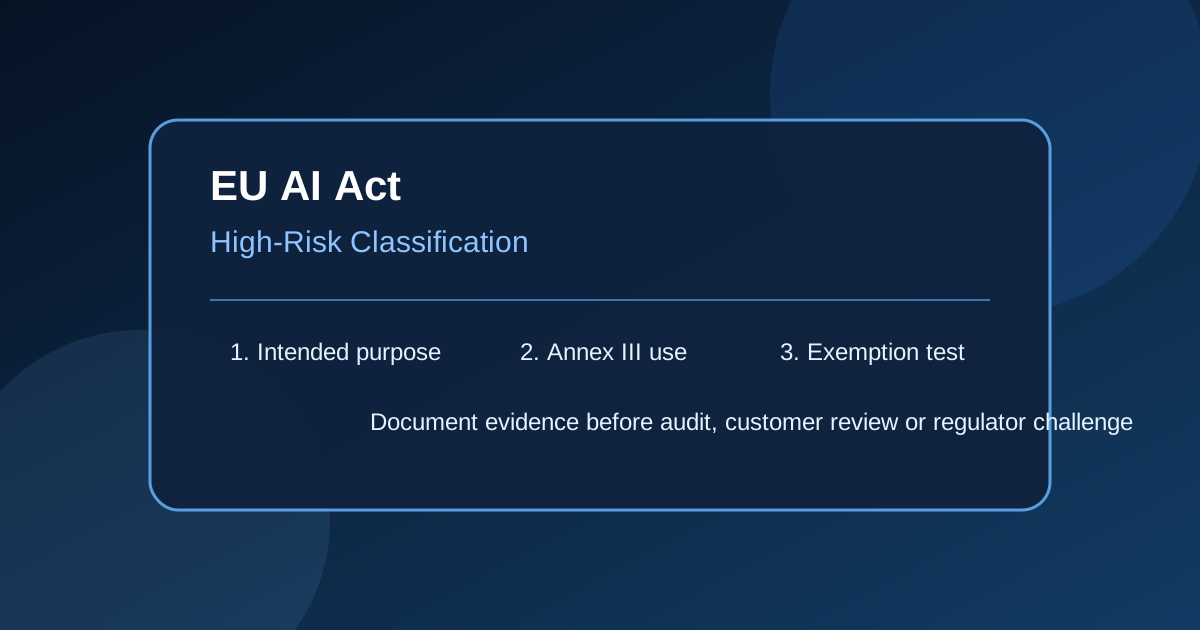
The first step is to define the AI system and its intended purpose with precision. A foundation model, a workflow, a feature inside a larger product, and a deployed decision-support tool are not always the same regulatory object. The same machine-learning component may be low-risk in one context and high-risk in another. Classification must therefore be tied to the concrete use case, not to the marketing name of the product.
The second step is to check whether the system is covered by Article 6(1) as a safety component of a product or by Article 6(2) and Annex III as a system used in one of the listed high-risk areas. Annex III includes areas such as biometrics, critical infrastructure, education and vocational training, employment and worker management, access to essential private and public services, law enforcement, migration and border control, and administration of justice or democratic processes.
The third step is to apply the exemption filter carefully. The AI Act recognises that some systems may be listed in a high-risk area but still not pose a significant risk because they perform a narrow procedural task, improve the result of a previously completed human activity, detect decision-making patterns without replacing or influencing them, or perform a preparatory task. These exemptions are attractive, but they are not a free pass. The organisation must be able to show why the system does not materially influence the relevant decision.
The exemption filter is where many teams will struggle
The most practical part of the guidance is the discussion of when a system may be exempt even though it sits near an Annex III use case. This is also the area where optimistic product teams are most likely to overreach. A system that merely formats information, deduplicates records, translates text, or routes a file may be easier to justify as procedural. A system that scores people, ranks candidates, recommends sanctions, prioritises inspection targets, or shapes access to a service is much harder to keep outside high-risk obligations.
The key phrase is material influence. If the AI output changes what a human sees, how options are ranked, which cases are escalated, or how scarce resources are allocated, it may influence the decision even if a human remains formally responsible. “Human in the loop” is not a magic shield. A human who routinely follows the AI recommendation, lacks time to review it, or cannot understand the basis of the output may not provide meaningful oversight.
That is why classification should not be performed only by legal and compliance staff. Product managers, data scientists, UX designers, process owners and business leaders all need to contribute. The regulatory risk often lives in workflow details: default rankings, thresholds, dashboard design, escalation queues, confidence scores and user incentives.
Annex III examples make the guidance concrete
The draft guidelines reportedly run to more than 160 pages because the Commission walks through the Annex III categories in detail. This is important for operational teams. The categories are broad, and each contains grey zones. A credit-scoring model, an applicant-screening tool, a student-performance predictor, a traffic-management optimiser and a public-benefit eligibility system all raise different questions.
For employment, the issue is not only whether the AI makes the final hiring decision. Tools used to screen CVs, rank candidates, analyse interviews, evaluate workers, allocate tasks, monitor performance or recommend dismissals may all be relevant. For education, systems that evaluate learning outcomes, decide access, detect cheating or influence admission can cross the line. For essential services, risk arises when AI affects access to credit, insurance, housing, healthcare, public benefits or other important services.
For critical infrastructure, the analysis must consider safety and continuity. AI used to optimise traffic flows, energy distribution, water systems or other infrastructure may have consequences beyond individual decisions. For biometrics, the guidance is particularly sensitive because remote biometric identification, emotion recognition and biometric categorisation have separate restrictions and prohibitions in the AI Act.
What providers should do now
Providers should start with an AI system inventory that is more detailed than a model list. The inventory should identify the intended purpose, user groups, deployment contexts, affected persons, input data, outputs, decision points, human oversight model, known limitations and integration dependencies. Without this level of detail, classification becomes guesswork.
Second, providers should prepare a classification memo for each AI system. The memo should map the system to Article 6 and Annex III, explain why a category does or does not apply, document any exemption relied upon, and identify evidence supporting the conclusion. This memo should be version-controlled and updated when the system changes. It should be short enough to be maintained, but precise enough to be useful under regulatory or customer scrutiny.
Third, providers should design the technical documentation pipeline early. If the system is high-risk, documentation cannot be assembled at the end by copying from Jira tickets and model cards. It must be built into the development lifecycle: data lineage, validation results, risk controls, human oversight instructions, logging design, cybersecurity assumptions and post-market monitoring plans.
Fourth, providers should prepare customer-facing information. Deployers will ask whether a system is high-risk, what obligations they inherit, what human oversight is required, how logs are retained, and what limitations must be communicated to users. A provider that can answer these questions clearly will have a commercial advantage.
What deployers should do now
Deployers should not wait passively for vendors to provide classification answers. The same product can be used in a low-risk or high-risk way depending on context. A general analytics tool may become high-risk if used to rank employees, triage benefit applications or influence access to education. Deployment context matters.
Deployers should create an intake process for new AI uses. The intake should ask: What decision or process does the AI influence? Who is affected? Is the domain listed in Annex III? Does the system rank, score, recommend, predict, classify or prioritise? Can a human realistically override the output? What evidence exists that the system is reliable for this population and context?
They should also review existing tools already embedded in HR, customer service, finance, operations, quality management and compliance. Many AI-enabled features are introduced through SaaS upgrades rather than formal AI projects. If procurement, legal and business owners do not coordinate, the organisation may have high-risk AI systems in production without knowing it.
The December 2027 delay does not mean “do nothing”
The LinkedIn discussion that triggered this article also highlighted political agreement to delay certain high-risk AI compliance dates to 2 December 2027. A delay changes sequencing, not direction. For serious organisations, the practical conclusion is to use the time for controlled preparation rather than last-minute compliance theatre.
There are several reasons. First, high-risk obligations touch architecture, data, contracts, quality management, monitoring and governance. These cannot be implemented credibly in a few weeks. Second, customers and investors increasingly ask AI governance questions before formal deadlines. Third, regulators and courts may use emerging guidance to interpret responsible behaviour even before full enforcement pressure arrives.
In other words, the delay is a planning window. It is not a holiday.
A practical classification worksheet
A simple worksheet can move teams from debate to evidence. For each AI system, record the system boundary, intended purpose, actual use, affected persons, Annex III category analysis, exemption analysis, human oversight model, vendor dependencies, evidence sources and final classification decision. Add a named owner and review date. This creates accountability.
The worksheet should include a “challenge” section. Ask what would make the conclusion wrong. Could users rely on the output more than expected? Could the feature be used in employment, education, credit or essential services even if originally designed for a benign purpose? Could future integrations change the risk category? These questions prevent narrow legalistic readings that collapse in real operations.
Implications for medical device and regulated-product teams
For medical device, machinery, automotive, industrial and other regulated-product teams, Article 6(1) is especially important. If AI is a safety component of a product or is itself a product covered by listed Union harmonisation legislation, high-risk obligations may apply through the product-safety route. This interacts with existing quality management, risk management and conformity assessment processes.
The good news is that regulated-product teams already understand documented processes, design controls, validation, post-market surveillance and change management. The challenge is to integrate AI-specific controls without creating a parallel bureaucracy. The best approach is to extend existing quality systems with AI-specific classification, data governance, monitoring and model-change controls.
Common mistakes to avoid
- Classifying the model instead of the use case. The same model can support both low-risk and high-risk systems. Classification follows intended purpose and deployment context.
- Assuming human review removes high-risk status. Human oversight is a control, not an exemption by itself.
- Ignoring SaaS features. AI capabilities introduced through vendor updates can create obligations even when no internal machine-learning project exists.
- Overusing the procedural-task exemption. A task is not narrow and procedural if it materially shapes a substantive decision.
- Leaving documentation until procurement or audit pressure arrives. Classification evidence is easier to collect when the system is being designed.
How to turn the guidance into an operating model
The most useful response is not a one-off legal memo. It is an operating model. Establish an AI intake process, maintain an inventory, create a classification standard, define escalation triggers, align procurement questionnaires, update vendor contracts, train product and business owners, and connect high-risk systems to quality and risk management processes.
For small and mid-sized organisations, this does not need to be heavy. A well-designed two-page intake form, a classification checklist, a decision log and a quarterly review meeting can be enough to start. The discipline matters more than the paperwork volume.
Conclusion
The Commission’s draft high-risk AI guidelines are valuable because they translate a complex legal framework into practical classification questions. They also make it harder to hide behind vague statements like “assistive only” or “not automated decision-making.” Organisations now have a clearer benchmark for explaining why an AI system is high-risk, not high-risk, or exempt.
The prudent move is to start classification work now. Build the inventory, write the memos, test the exemptions, involve the people who understand the workflow, and prepare evidence before customers, auditors or regulators ask for it. That is how AI governance becomes a management system rather than a scramble.
Sources: European Commission draft guidelines on the classification of high-risk AI systems, targeted consultation materials, and public LinkedIn commentary by Oliver Patel on the publication of the guidelines.
