
The EU AI Act Delay Changes More Than the Calendar for MedTech and Other High-Risk AI Teams
The latest signal from Brussels is not that the EU AI Act is becoming softer. It is that the political timetable is slipping.
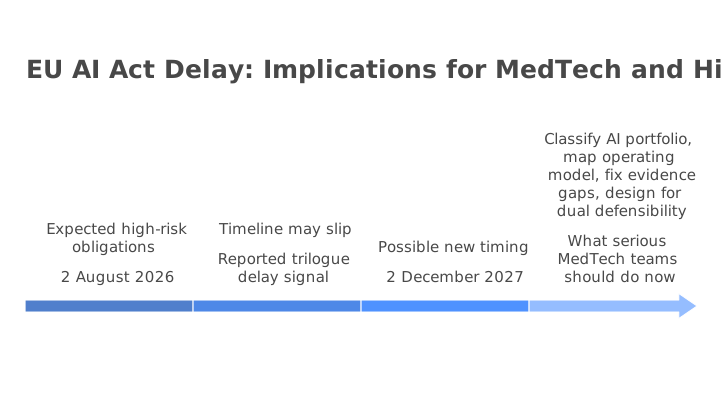
According to current reporting around the stalled trilogue negotiations, the obligations many teams expected to hit on 2 August 2026 may now move closer to 2 December 2027. If that shift holds, some organisations will treat it as breathing room. That would be understandable. It would also be risky.
A delayed deadline does not change the direction of travel. For high-risk AI, especially product-regulated AI such as medical devices, the hard part is not the date. It is building the operating model that can survive scrutiny when the date arrives.
What appears to be delayed
The immediate issue is timing for the more operationally heavy parts of the AI Act, especially the requirements relevant to high-risk systems. That matters most for organisations building or deploying AI that falls under Annex I product regimes or otherwise lands in the high-risk category.
For MedTech teams, this is not an abstract policy debate. It affects planning for documentation, quality integration, testing evidence, post-market controls, supplier governance, and how AI-specific controls fit alongside existing MDR or IVDR obligations.
Why Annex I teams should pay closer attention than everyone else
There is a difference between general-purpose corporate AI experimentation and AI that sits inside a regulated product context. If your system is connected to a medical device, influences clinical decision-making, or enters another product-regulated pathway, the governance burden is structurally different.
Annex I and other product-regulated teams already live in a world of controlled design, traceability, evidence expectations, and lifecycle accountability. The AI Act does not replace that world. It adds another layer that has to integrate with it cleanly.
That is why a delay can be deceptive. Organisations with lighter AI use cases may be able to defer maturity work without immediate pain. Product-regulated AI teams usually cannot. Their quality and regulatory architecture still has to become coherent across both regimes.
The real impact is on sequencing, not seriousness
If the timeline moves, leaders should not read that as a reduction in regulatory seriousness. The better reading is that sequencing may change.
- Budget timing may shift, which can help teams stage work more intelligently.
- Programme pressure may ease temporarily, especially where multiple regulatory changes are colliding.
- But architectural decisions should not be postponed, because those are exactly the decisions that take longest to unwind if made badly.
In practice, the extra time is most valuable when used to build something deliberate rather than to preserve ambiguity for another year.
For MedTech, delay does not remove the integration problem
The most important MedTech question is not "when exactly does this apply?" It is "how do we integrate AI Act expectations into the quality, regulatory, and technical systems we already depend on?"
That includes issues such as:
- how AI risk management aligns with existing ISO 14971 and post-market processes,
- how training data, validation evidence, and performance monitoring are documented credibly,
- how change control works when models evolve or are retrained,
- how human oversight is defined in real workflows rather than marketing language,
- and how suppliers, components, and downstream deployers are governed contractually and operationally.
None of that becomes easier if teams wait until the politics settle completely.
Three mistakes I would expect after a delay signal
1. Treating schedule relief as compliance relief
This is the most obvious trap. If the date moves, some boards will quietly downgrade urgency. That is a mistake because the work that matters most is capability-building, not calendar management.
2. Running AI Act work as a standalone legal project
Especially in regulated industries, this fails quickly. The AI Act has legal implications, but implementation lives across quality, engineering, product, regulatory, data, and post-market functions.
3. Waiting for final perfect certainty before designing the control model
Perfect certainty almost never arrives in time to be useful. Teams should separate what is still politically fluid from what is already operationally obvious.
What should happen now instead
If I were advising a MedTech or other high-risk AI leadership team right now, I would recommend using the possible delay to do four things well:
- Classify the AI portfolio properly. Separate low-dependence experiments from product-regulated or safety-relevant systems.
- Map the operating model. Identify where AI governance must plug into quality, risk, clinical, regulatory, cybersecurity, and supplier controls.
- Fix evidence gaps early. Data provenance, validation logic, intended use boundaries, and monitoring plans are usually weaker than leadership assumes.
- Design for dual defensibility. Build a model that makes sense both under existing product regulation and under emerging AI-specific scrutiny.
My view
The likely delay is real news, but it is not the kind of news that should slow serious organisations down. It should make them more precise.
For high-risk AI teams, and especially for medical device companies, the opportunity here is not to postpone effort. It is to replace deadline panic with structured integration work that should have happened anyway.
Conclusion
If the EU AI Act timetable for high-risk obligations moves from August 2026 toward December 2027, many organisations will gain time. The smart ones will use it to reduce rework, strengthen governance, and align AI-specific controls with the realities of regulated product delivery.
For MedTech and other Annex I contexts, that is the real issue. The date may move. The accountability does not.
