EU AI Act Amendments 2026: What the European Parliament Vote Means for Your Compliance Strategy
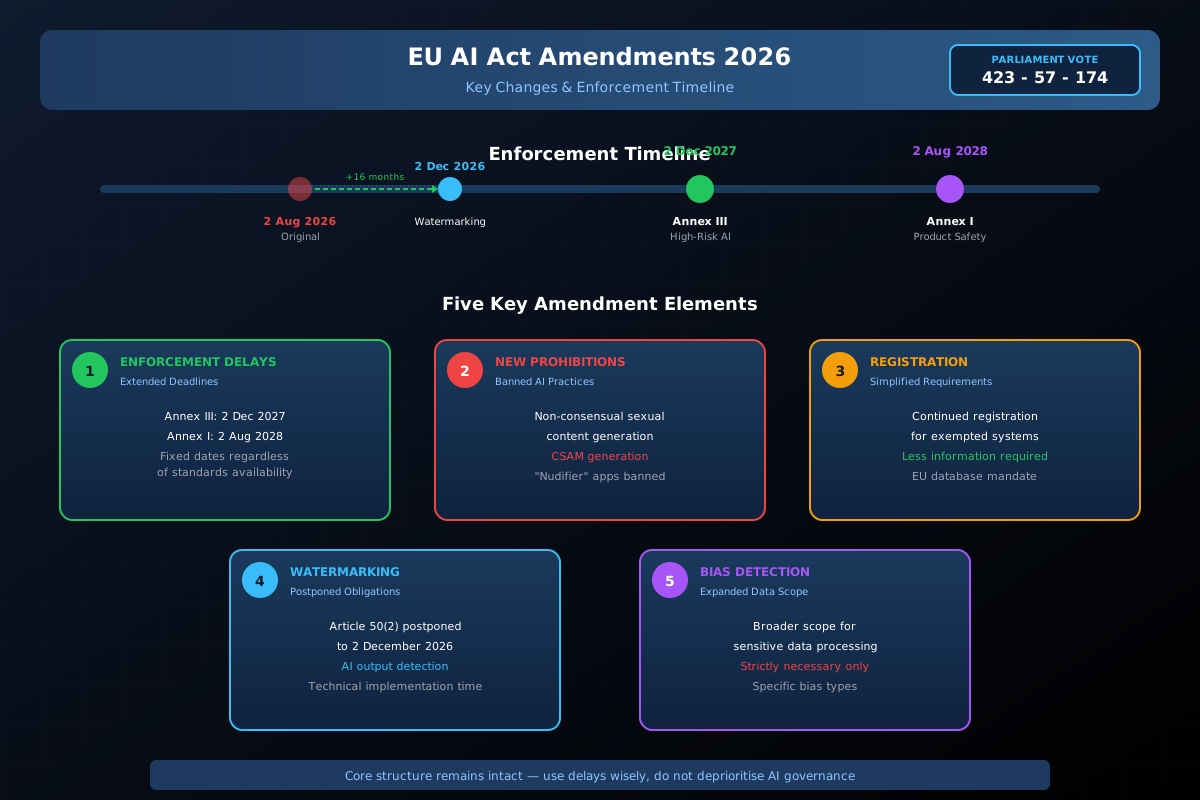
In a landmark decision that will reshape the compliance landscape for artificial intelligence across Europe, the European Parliament has voted overwhelmingly to amend the EU AI Act. The vote—423 Members of European Parliament (MEPs) in favour, 57 against, with 174 abstentions—signals broad political consensus for simplifying and streamlining key elements of the world's most comprehensive AI regulation.
This amendment, which follows the political agreement reached between the Council of EU member states and the European Commission last month, is now overwhelmingly likely to be formally passed into law within the coming weeks. The timing is significant: these changes provide breathing room before the original 2 August 2026 enforcement deadline, giving organisations additional time to prepare for compliance while the core regulatory framework remains intact.
Although the timeline changes are headline-grabbing, the core structure and logic of the AI Act remains broadly intact. Organisations should not use the delays as a reason to deprioritise their AI governance programs.
Understanding the Amendment's Core Objectives
The amendments to the EU AI Act represent a pragmatic response to feedback from industry stakeholders, civil society, and regulatory experts who identified implementation challenges in the original text. The omnibus regulation's stated aim is to simplify and streamline key elements of the EU AI Act in support of European businesses and economic competitiveness—without undermining the fundamental protections the regulation was designed to provide.
This balancing act reflects a mature approach to regulation: maintaining high standards for AI safety, transparency, and accountability while reducing unnecessary administrative burdens and providing realistic timelines for implementation. The European Parliament's decisive vote suggests that policymakers have listened to concerns about readiness and proportionality while standing firm on the principle that AI development must be responsible and human-centric.
Key Amendment Element 1: Delay of Enforcement Dates for High-Risk AI Systems
The most significant change for most organisations involves the extension of enforcement deadlines for high-risk AI systems. These delays provide much-needed additional time for companies to complete their compliance preparations, particularly for those working with complex AI applications in regulated sectors.
Annex III Systems: Extended to December 2027
High-risk AI systems listed in Annex III of the AI Act—covering applications in critical infrastructure, education, employment, essential services, law enforcement, migration, and administration of justice—now have until 2 December 2027 to achieve compliance. This represents a 16-month extension from the original deadline of 2 August 2026.
Annex III includes some of the most widely deployed AI applications in business contexts: AI systems used for recruitment and selection, credit scoring, exam scoring, and access to essential services. The extended timeline recognises the complexity of implementing risk management systems, data governance frameworks, and human oversight mechanisms for these high-stakes applications.
Annex I Systems: Extended to August 2028
For AI systems covered by Annex I—those integrated into products already regulated under EU product safety legislation—the deadline extends to 2 August 2028. This represents a 24-month delay from the original timeline.
Annex I systems include AI components in medical devices, machinery, toys, lifts, and other products falling under the New Legislative Framework (NLF) harmonised legislation. These systems face the dual challenge of complying with both sector-specific product safety requirements and the AI Act's provisions, making the extended timeline particularly valuable for manufacturers navigating complex conformity assessment procedures.
Fixed Dates Regardless of Standards Availability
A critical aspect of these new deadlines is that they are fixed, irrespective of the availability of harmonised standards and common specifications. This provides certainty for planning purposes: organisations can commit resources knowing that deadlines will not slip further due to standardisation delays.
This certainty is important because the development of technical standards for AI systems has proven slower than initially anticipated. The European standardisation organisations (CEN-CENELEC) have been working on standards to support AI Act compliance, but complex technical and stakeholder processes have meant that some key standards remain under development. The Parliament's decision to fix the dates regardless removes uncertainty and allows organisations to proceed with compliance efforts based on the statutory requirements rather than waiting for standardisation completion.
Key Amendment Element 2: New Prohibited AI Practices
The amendments expand the list of prohibited AI practices under Article 5 of the AI Act, adding a new category of banned applications that reflects growing concerns about the malicious use of AI technologies.
Non-Consensual Sexual Content Generation
AI systems capable of generating non-consensual sexual and intimate content have been added to the list of prohibited practices. This directly targets so-called "nudifier" applications and similar technologies that can create explicit images of individuals without their consent.
The inclusion of this prohibition represents a rapid legislative response to an emerging threat. The technology to generate synthetic explicit imagery has become increasingly accessible, raising serious concerns about privacy violations, harassment, and the potential for such content to be used for extortion or reputational harm. By explicitly prohibiting these systems, the EU is sending a clear signal that technological capabilities do not override fundamental rights to dignity and privacy.
CSAM Generation Capabilities
The amendment also prohibits AI systems capable of generating child sexual abuse material (CSAM). While the production and distribution of such material was already illegal under criminal law across the EU, the explicit inclusion in the AI Act ensures that AI systems designed to generate such content are caught by the regulation's prohibitions and enforcement mechanisms.
This prohibition is absolute and carries the highest penalties under the AI Act framework. Providers of such systems face fines of up to 35 million EUR or 7% of global annual turnover—whichever is higher—reflecting the severe harm such technologies enable.
Key Amendment Element 3: Changes to Registration Requirements
The amendments modify the registration requirements for providers of AI systems, introducing a more proportionate approach to the information that must be submitted to the EU's public database.
Continued Registration for Exempted Systems
Registration in the EU database continues to be mandated for providers of "exempted" AI systems—those deemed not to be high-risk due to a derogation or exemption. This ensures transparency even for systems that fall outside the high-risk category.
The principle here is important: even when an AI system is not classified as high-risk, the public and regulators should have visibility into its existence, purpose, and basic characteristics. This transparency supports market surveillance, enables affected individuals to understand when AI systems are being used, and allows competitors to assess the regulatory landscape.
Reduced Information Requirements
However, the amendments specify that less information needs to be registered for these exempted systems compared to high-risk systems. This reduces the administrative burden on providers of lower-risk AI applications while maintaining the transparency benefits of registration.
The exact specifications of what information will be required versus what can be omitted will be detailed in implementing acts. Organisations should monitor European Commission guidance to understand the specific registration fields and data formats. The key principle is proportionality: the information collected should be sufficient for transparency and oversight purposes without imposing unnecessary compliance costs on providers of low-risk applications.
Key Amendment Element 4: Postponement of Watermarking Obligations
The amendments include a targeted postponement of obligations related to AI output detection and watermarking, providing additional time for technical implementation of these technically challenging requirements.
Article 50(2) Obligations Delayed to December 2026
The enforcement date for generative AI output detection and watermarking obligations under Article 50(2) of the AI Act has been postponed to 2 December 2026.
Article 50(2) requires providers of AI systems that generate synthetic content to ensure that the outputs are marked in a machine-readable format, and to make available technical documentation to demonstrate how this is achieved. The goal is to enable detection of AI-generated content, supporting transparency and helping to combat deepfakes and misinformation.
Technical Implementation Challenges
The postponement reflects genuine technical challenges in implementing robust, interoperable watermarking systems. Several approaches are under development—including metadata embedding, imperceptible watermarking, and cryptographic provenance systems—but none has yet achieved widespread standardisation or proven robustness against removal or spoofing.
For organisations developing or deploying generative AI systems, this delay provides additional time to evaluate watermarking technologies, participate in standardisation efforts, and implement solutions that will meet the regulatory requirements when they take effect. However, organisations should not treat this as a reason to delay preparatory work: December 2026 is closer than it appears, and implementation of effective watermarking may require significant technical effort.
Key Amendment Element 5: Broader Scope for Bias Detection Using Sensitive Data
The amendments expand the circumstances under which organisations can lawfully process sensitive personal data for bias detection and correction purposes, addressing a tension between AI Act requirements and GDPR restrictions.
Expanded Legal Basis for Sensitive Data Processing
The amendments create a broader scope for organisations to process sensitive personal data—including data revealing racial or ethnic origin, political opinions, religious beliefs, trade union membership, genetic data, biometric data, health data, and data concerning sex life or sexual orientation—for the specific purpose of bias detection and correction.
Under the GDPR, processing of such special category data is generally prohibited except where specific conditions apply. The AI Act amendments provide a tailored legal basis for this processing when it is necessary to identify and address biases in AI systems, recognising that such biases often manifest along precisely these protected characteristics.
Strict Necessity and Specific Bias Types
However, this expanded scope comes with important limitations. Processing must still be "strictly necessary" and only to address specific types of biases. This means organisations cannot collect and process sensitive data speculatively or for broad analytical purposes. The processing must be targeted, proportionate, and directly linked to identifiable bias concerns.
For AI governance professionals, this creates a framework that requires careful documentation: organisations should be able to demonstrate which specific biases they are investigating, why sensitive data is necessary for that investigation, and what safeguards are in place to protect the data during and after the bias detection process. Data protection impact assessments (DPIAs) should be updated to reflect this processing and the specific legal basis under both GDPR and the amended AI Act.
Practical Implications for Business Executives
The amendments create a changed but still demanding compliance environment. Business leaders should understand both the opportunities and the ongoing obligations these changes create.
Strategic Planning with Extended Timelines
The extended deadlines provide valuable breathing room for strategic planning. Rather than rushing to meet an August 2026 deadline that many organisations would have struggled to achieve, companies now have 16 to 24 additional months to implement comprehensive AI governance frameworks.
This additional time should be invested wisely. Organisations should use it to conduct thorough AI inventories, classify their AI systems according to the AI Act's risk categories, implement risk management systems, establish data governance processes, and build human oversight capabilities. The organisations that use this time effectively will have sustainable competitive advantages over those that treat the delay as a reason to postpone action.
Budget Reallocation Opportunities
Extended timelines may enable more efficient budget allocation. Rather than emergency spending to meet an imminent deadline, organisations can spread compliance investments over a longer period, integrating AI governance into normal capital and operational expenditure cycles.
This can also enable more strategic procurement decisions. Organisations have time to evaluate compliance tools, risk management platforms, and consulting support rather than making rushed purchasing decisions. The market for AI governance solutions will continue to mature over the extended timeline, potentially offering better options at lower costs.
Competitive Positioning
The amendments do not change the fundamental competitive dynamic: organisations that can demonstrate AI Act compliance will have advantages in accessing the European market, particularly for high-risk applications. The extended timeline means that early movers in compliance can establish market positions before competitors catch up.
For B2B companies, AI Act compliance will increasingly become a procurement requirement. Large enterprises and public sector buyers will favour vendors who can demonstrate compliance with EU AI regulations. Organisations that achieve compliance early can use this as a competitive differentiator and potentially command premium pricing for compliant AI solutions.
Practical Implications for Compliance Officers
Compliance professionals face a complex task: maintaining momentum on AI governance programs while adjusting plans to reflect the new timelines and requirements.
Revised Implementation Roadmaps
Compliance officers should update their AI Act implementation roadmaps to reflect the new deadlines. This involves recalibrating project timelines, adjusting resource allocations, and communicating changes to stakeholders who may have been planning for the August 2026 deadline.
Roadmaps should be realistic but not relaxed. The core compliance requirements—risk management systems, data governance, technical documentation, human oversight, and quality management—still need to be implemented. The question is not whether to comply, but how to use the additional time to achieve more robust, sustainable compliance.
Monitoring Standards Development
Although the enforcement dates are now fixed regardless of standards availability, harmonised standards will still provide valuable guidance for compliance. Compliance officers should continue monitoring the work of CEN-CENELEC on AI Act standards, as these will inform best practices and may be referenced in conformity assessment procedures.
Participation in industry associations and standards development processes can provide early visibility into emerging standards. This can inform compliance strategies and ensure that implementations align with emerging industry norms.
Addressing New Prohibitions
The new prohibited practices require immediate attention. Compliance officers should review their organisations' AI portfolios to ensure that no systems fall into the newly prohibited categories. While most legitimate business applications will not be affected, the prohibitions on non-consensual content generation are broad and could potentially catch systems developed for legitimate purposes but capable of misuse.
Legal review of AI capabilities should be conducted to assess whether any systems have functionalities that could be interpreted as falling within the prohibited categories. Documentation of legitimate purpose and technical safeguards should be maintained for systems in borderline areas.
Practical Implications for AI Governance Professionals
AI governance teams play a critical role in translating regulatory requirements into operational practices. The amendments create both opportunities and new responsibilities for these teams.
Bias Detection Program Development
The expanded scope for sensitive data processing in bias detection creates opportunities for more thorough fairness assessments. AI governance teams should develop structured programs for identifying, measuring, and addressing biases in AI systems, leveraging the amended provisions where appropriate.
These programs should include clear protocols for when sensitive data processing is justified, how such processing will be conducted, and what safeguards will apply. Collaboration with data protection officers will be essential to ensure that bias detection activities comply with both the AI Act amendments and GDPR requirements.
Watermarking Strategy Preparation
The postponed watermarking obligations provide time for thoughtful strategy development rather than rushed implementation. AI governance teams should use this time to evaluate watermarking technologies, assess their applicability to the organisation's generative AI systems, and develop implementation plans.
Key considerations include: the technical robustness of different watermarking approaches, their impact on system performance, compatibility with existing infrastructure, and resilience against removal or circumvention. Organisations should also monitor industry developments, as common practices and potentially standards may emerge before the December 2026 deadline.
Registration Process Preparation
While the information requirements for exempted systems are reduced, the registration obligation itself remains. AI governance teams should prepare for registration by ensuring that AI inventories are complete, classification decisions are documented, and the required information can be readily compiled.
Registration will be conducted through a European Commission database system. Teams should familiarise themselves with the expected data fields and registration procedures, monitoring for European Commission guidance on the practical operation of the registration system.
Maintaining Momentum: Why Deprioritisation Is a Mistake
The most important message for organisations following these amendments is that the core compliance requirements remain unchanged. The AI Act's fundamental structure—risk-based classification, obligations for high-risk systems, prohibitions on unacceptable risk applications, and governance requirements for general-purpose AI models—remains intact.
The Compliance Fundamentals Persist
High-risk AI systems will still need risk management systems, data governance frameworks, technical documentation, record-keeping capabilities, transparency measures, human oversight, and accuracy assurance. These requirements are not delayed; only the enforcement date for full compliance is extended.
Organisations that use the extended timeline to build robust, sustainable compliance capabilities will be better positioned than those that delay and face compressed implementation timelines later. The work required to comply with the AI Act is substantial; spreading it over a longer period is prudent, but eliminating it would be reckless.
Regulatory Expectations
Regulators will expect organisations to use the extended timelines responsibly. Market surveillance authorities will be looking for evidence that organisations are making genuine progress toward compliance, not simply deferring all activity. Demonstrable progress on AI governance—including completed inventories, documented risk assessments, and implemented controls—will be important in any regulatory interactions.
Business and Reputational Risks
Beyond regulatory compliance, organisations face business and reputational risks from inadequate AI governance. AI systems that produce biased outcomes, lack transparency, or operate without adequate oversight can cause significant harm to individuals, leading to reputational damage, legal liability, and loss of customer trust.
The extended timeline provides an opportunity to implement AI governance that goes beyond minimum compliance to genuinely responsible AI practices. Organisations that take this opportunity will build stronger, more sustainable relationships with customers, employees, and regulators.
Actionable Recommendations for Organisations
Based on the amendments and their implications, we recommend the following actions for organisations developing or deploying AI systems in Europe:
- Conduct a comprehensive AI inventory. Document all AI systems in use or development, classify them according to AI Act risk categories, and identify which deadlines apply to each system. Update this inventory as the regulatory landscape evolves.
- Review systems against new prohibitions. Assess whether any AI capabilities could be interpreted as falling within the newly prohibited categories of non-consensual content generation or CSAM creation. Document legitimate purposes and safeguards for any borderline systems.
- Develop a revised implementation roadmap. Adjust project timelines to reflect the new enforcement dates while maintaining momentum on core compliance activities. Spread investments over the extended timeline but ensure that critical path items remain on schedule.
- Establish bias detection capabilities. Develop structured programs for identifying and addressing AI biases, taking advantage of the expanded provisions for sensitive data processing where strictly necessary. Collaborate with data protection officers to ensure GDPR compliance.
- Prepare for watermarking implementation. Evaluate watermarking technologies and develop implementation strategies for generative AI systems. Use the extended timeline to make informed technology choices rather than rushed implementations.
- Maintain registration readiness. Ensure that AI system information can be readily compiled for registration purposes. Monitor European Commission guidance on registration procedures and reduced information requirements.
- Invest in governance infrastructure. Use the extended timeline to build sustainable AI governance capabilities, including risk management processes, oversight mechanisms, and organizational competencies. Treat compliance as an ongoing capability, not a one-time project.
- Engage with standards development. Participate in industry associations and monitor harmonised standards development. Early visibility into emerging standards can inform compliance strategies and implementation approaches.
- Communicate with stakeholders. Ensure that boards, executive teams, and business units understand the amendments and their implications. Manage expectations about both the extended timelines and the ongoing compliance obligations.
- Seek expert guidance. Consider engaging external expertise to navigate the complexities of AI Act compliance, particularly for high-risk applications and complex organisational contexts. The investment in proper guidance now can prevent costly remediation later.
Conclusion: Navigating the Amended Landscape
The European Parliament's amendments to the EU AI Act represent a pragmatic evolution of the world's most comprehensive AI regulation. The extended timelines provide valuable breathing room for organisations to achieve compliance, while the new prohibitions and adjusted requirements reflect emerging understanding of AI risks and practical implementation challenges.
For business executives, compliance officers, and AI governance professionals, the message is clear: the destination has not changed, only the timeline for reaching it. The AI Act's core requirements for high-risk systems remain in force, and organisations that use the extended deadlines to build robust, sustainable compliance capabilities will be best positioned for success in the European AI market.
The amendments should be seen not as a reason to deprioritise AI governance, but as an opportunity to do it right. With thoughtful planning, appropriate investment, and sustained commitment, organisations can turn regulatory compliance into competitive advantage—building AI systems that are not only legally compliant but genuinely trustworthy, transparent, and aligned with European values.
The European Parliament has given European businesses the gift of time. How organisations use that time will determine their success in the AI-powered economy of the future.
