The Risks Security Teams Underestimate in AI
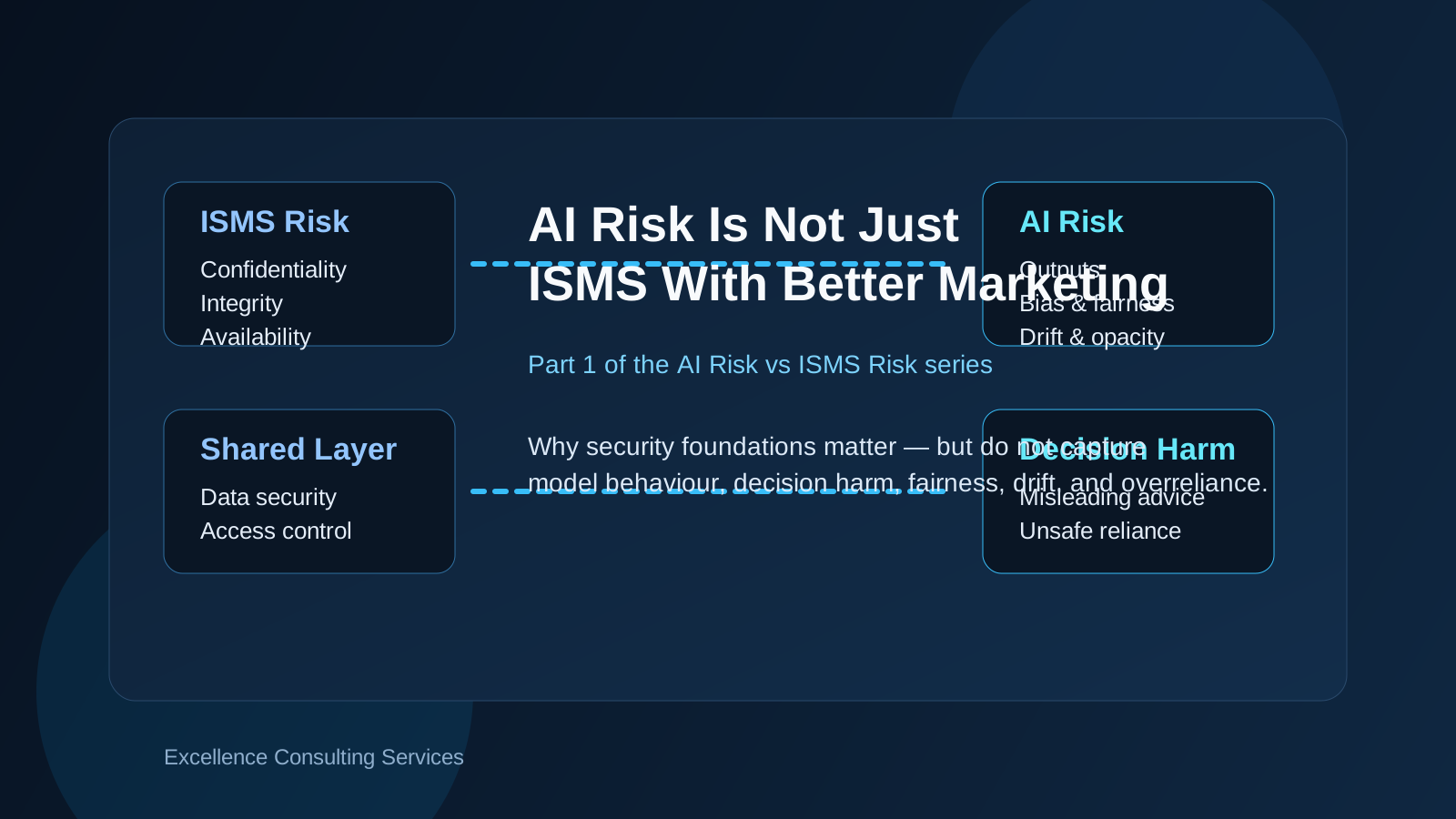
By Part 4 of this series, the architecture of the argument should be clear. AI risk is not just another ISMS topic. AI risk and ISMS risk differ in object, failure mode, evidence, and ownership. Cybersecurity and AI governance collide in real systems. Now we get to the part that often changes executive attention.
Even when security teams do many things well, they can still underestimate some of the most consequential AI risks.
That is not because security teams are careless. It is because they are trained to detect compromise, intrusion, exposure, disruption, and control breakdown. AI can fail in those ways, but it can also fail in ways that look operationally normal right up until harm appears.
In AI, some of the biggest failures happen without a breach. The model simply behaves badly, and the organisation notices too late.
Why strong security discipline still misses some AI failures
Security teams are used to clear signals: suspicious access, malware, data exfiltration, configuration drift, unpatched systems, service outages, or supplier compromise. These are concrete and often observable.
AI harms are often softer at first. They may look like an answer that sounds right but is wrong, a summary that omits a critical nuance, a recommendation that is statistically weaker for one group than another, a confidence signal that the user interprets too strongly, or a model that becomes slightly worse over time without crossing a dramatic alert threshold.
None of those necessarily triggers a conventional security alarm. And yet any one of them can create legal, operational, ethical, clinical, or reputational damage.
Hallucinations are not just bad answers
Hallucination risk is still underestimated because many teams treat it like an annoyance rather than a governance issue. That is fine in low-stakes experimentation. It is reckless in high-dependence workflows.
A hallucination is not just incorrect text. It is an output that can sound authoritative, appear contextually grounded, move faster than human review, and shape decisions before anyone notices it was wrong.
In a policy-search assistant, a hallucinated interpretation can quietly distort internal compliance behaviour. In customer support, it can generate commitments the company should not make. In risk analysis, it can create false confidence around incomplete evidence.
Bias rarely announces itself like an incident
Bias does not necessarily arrive as a dramatic system failure. More often, it appears as a pattern: some users are disadvantaged more often than others, certain language styles produce better outcomes than others, particular cases get misclassified more frequently, or the model performs well on average but badly at the edges that matter most.
This is one reason AI bias should not be framed as a purely ethical topic. It is also a governance, quality, and accountability issue.
Weak explainability becomes a business risk quickly
A secure system that produces an answer nobody can meaningfully explain may still be unacceptable in many real settings.
When something goes wrong, leaders need to know why the output was produced, whether it can be contested, whether it can be reproduced, whether a human could reasonably detect the issue before acting, and whether the organisation can defend the logic to auditors, regulators, customers, or courts.
Explainability stops being a nice-to-have and becomes an operational control.
Silent drift is one of the most dangerous AI risks
Security teams understand configuration drift and unauthorised change. Model drift is different. It means the relationship between the model and the real world is changing.
The infrastructure may be stable. The access model may be correct. The logs may be present. And still, performance may be degrading. The model may become less accurate, less reliable on edge cases, more brittle under new inputs, or less aligned with current policy or business conditions.
Nothing needs to look broken in the classical sense. That is why drift is so dangerous.
Human overreliance is a real control failure
One of the biggest AI risks is not only what the model does. It is what people stop doing once the model is present.
Users may stop checking answers carefully, treat drafts like final outputs, assume consistency where none exists, defer judgment because the system sounds more confident than they feel, or fail to escalate because the model made the result feel already analysed.
Teams often say there is a human in the loop, as if that alone closes the risk. But a human in the loop is not meaningful if the workflow nudges the human to rubber-stamp rather than review.
Reliability is context-specific, not global
A common mistake in AI deployment is to talk about model quality as if it were a single property. But AI systems are often reliable in one context and fragile in another.
An internal assistant may be good at summarising stable policies, weaker at interpreting exceptions, acceptable for low-risk drafting, and unsafe for final decision support. Governance must classify where the system is trusted, where it is constrained, and where it must not be used at all.
The recurring internal AI assistant shows the real stakes
- it hallucinates a policy interpretation that gets copied into an internal decision memo
- it performs worse on ambiguous or poorly written internal queries, disadvantaging some users more than others
- it produces summaries that are impossible to trace back clearly enough for an audit challenge
- it becomes less accurate after policy changes, but users keep trusting it because the interface looks unchanged
- support staff rely on its tone and speed so heavily that weak caveats go unnoticed
This is the moment when many teams realise they were governing the system’s environment more effectively than they were governing the system’s consequences.
Why these risks escalate fast at executive level
A hallucination can become a legal issue. A biased pattern can become a reputational issue. A weakly explainable output can become an audit issue. Drift can become an operational issue. Overreliance can become a safety or quality issue.
That is why AI risk cannot be left inside technical teams alone. The harm often materialises where the technical team is not the final decision-maker.
A better control mindset for these risks
The right response is not panic. It is precision.
Organisations need to define where hallucination risk is acceptable and where it is not, what fairness checks are relevant for each use case, when explainability is mandatory, what drift indicators matter operationally, what human review must look like in practice, and where the model is advisory only versus decision-influencing.
Conclusion
Some of the most serious AI risks are exactly the ones strong security teams can still underestimate. Hallucinations, hidden bias, weak explainability, silent drift, overreliance, and context-specific reliability do not always look like classical security failures. But they can create damage just as real.
That is why AI governance must extend beyond cybersecurity without abandoning it. And once organisations understand these hidden AI-specific risks, the next question becomes unavoidable: who should actually own them, and what governance model makes that ownership real?
That is where Part 5 goes next.
