Where They Collide: The Shared Zone Between Cybersecurity and AI Governance
In Part 1, I argued that AI risk does not fit neatly inside a traditional ISMS. In Part 2, I made the distinction more explicit. At that point, some readers make a new mistake: they swing too far in the other direction and start talking as if AI risk and cybersecurity are separate universes with minimal contact.
That is wrong too.
AI systems live inside technical environments, depend on information flows, rely on vendors, expose interfaces, inherit access models, and create new attack paths. So while AI governance is broader than cybersecurity, it is also deeply entangled with it.
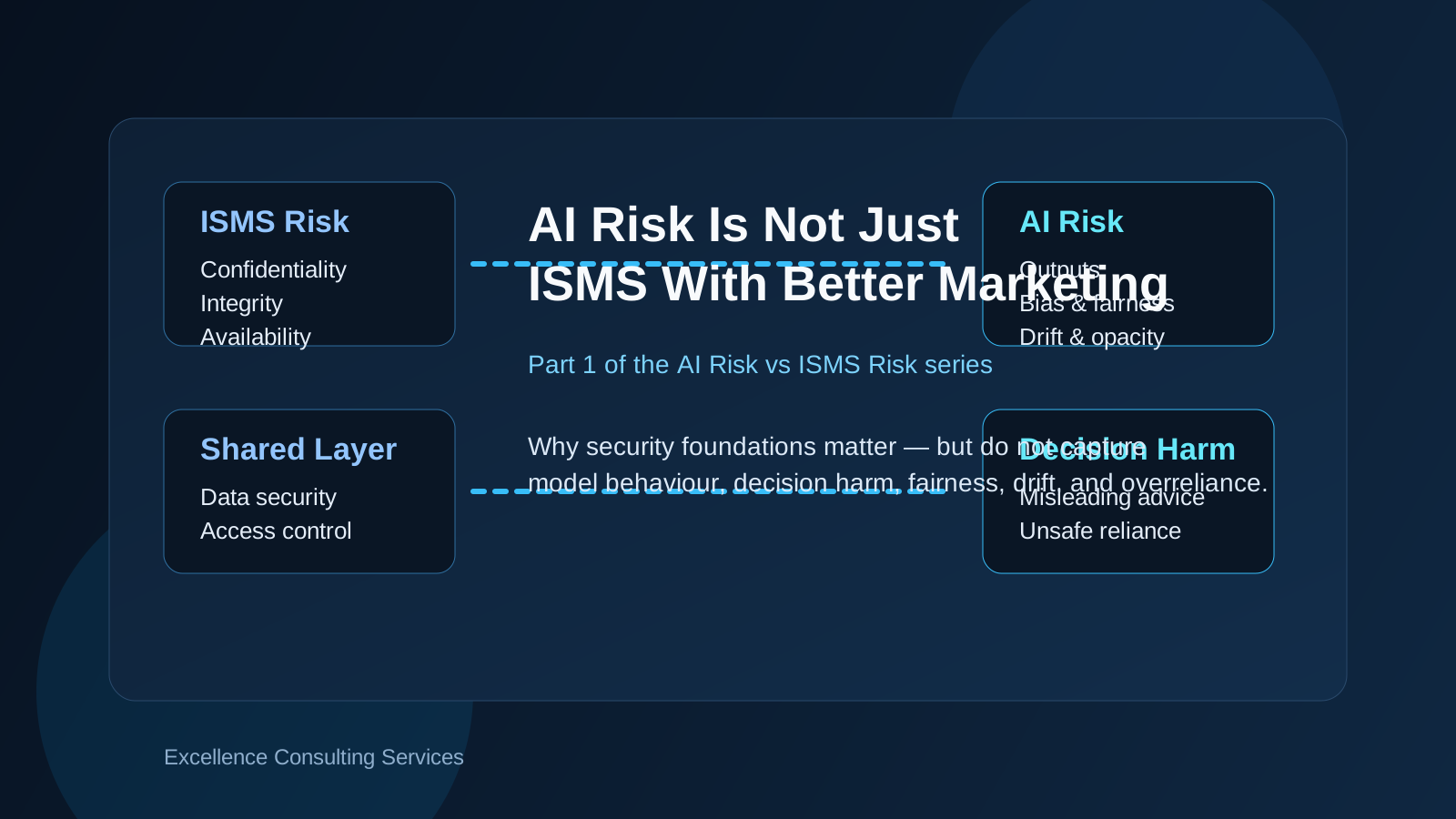
ISMS protects the environment around AI, while AI governance protects the behaviour and consequences inside it. In real systems, those two layers constantly interact.
Why the overlap matters more than the distinction alone
The distinction matters because otherwise organisations treat AI as just another application. But the overlap matters because otherwise organisations build governance theatre.
They create an AI governance discussion that floats above the infrastructure, data pipelines, vendors, interfaces, and operational controls that actually shape the risk.
That usually leads to one of two failures: security teams assume AI governance is someone else’s abstract ethics project, or AI governance teams assume security basics are stable and solved even when they are not.
The overlap zone begins with data
Data is one of the clearest places where cybersecurity and AI governance collide.
From a classical ISMS perspective, the questions are familiar: who can access the data, is it encrypted, is access logged, is the source approved, and is the storage environment trustworthy?
But AI adds another layer: is the data representative enough for the use case, was it collected under the right permissions, does it introduce bias, can the organisation trace which data shaped which model behaviour, and what happens when the data distribution changes over time?
Training data is not just another protected asset. It is also a behavioural input into the model.
Access control is no longer only about who logs in
AI changes the meaning of access in at least three ways:
- Access to the model: who can query it, fine-tune it, change prompts, or connect it to tools and internal knowledge.
- Access through the model: a user may not have direct access to a dataset, but the model may still expose sensitive information through answers or summaries.
- Access to influence the model: poisoned data, prompt manipulation, or unsafe integration logic may steer behaviour.
That means access control in AI environments is no longer only about perimeter and identity. It is also about what the model can reveal, invoke, infer, or be steered into doing.
Prompt injection is the overlap zone in one sentence
If you want a single example that captures the collision between cybersecurity and AI governance, prompt injection is a strong candidate.
It is simultaneously a security issue, a trust boundary issue, a model behaviour issue, a system design issue, and a governance issue.
A classical secure system might treat an input as harmless text. An AI system may treat that same input as behavioural guidance. That is exactly why old security assumptions are not enough on their own.
Supply chain risk gets wider with AI
ISMS teams already understand third-party and supply chain risk. AI expands the supply chain in ways many organisations still underestimate.
The dependency map may now include base model providers, hosted APIs, open-source model weights, vector databases, retrieval pipelines, prompt orchestration tools, evaluation frameworks, fine-tuning data suppliers, and plugin or tool integrations.
The risk is not only whether a vendor is breached. It is also whether the provider changes model behaviour unexpectedly, safety settings shift, the model degrades on your use case, data retention rules are unclear, or hidden dependencies break your assurance logic.
Logging and traceability become much harder — and more important
Security teams rely on logging for monitoring, investigation, and incident response. AI governance needs logging too, but for additional reasons: reconstructing why an output was produced, tracing which prompt or retrieval result influenced an answer, proving what level of human review occurred, and understanding when model behaviour changed.
If a model gives harmful advice, it may not be enough to know that a user opened the tool at 10:03 and submitted a query. You may also need to know what the exact prompt was, which model version responded, what context was retrieved, and whether the user edited the output before acting on it.
Incident response needs a broader trigger language
AI systems can trigger classic incidents, but they can also create other conditions that deserve escalation: repeated hallucinations in a sensitive workflow, abnormal drift, unsafe or biased response patterns, retrieval leakage, prompt injection attempts, or automation actions executed on weak reasoning.
Many of these do not fit neatly into existing incident taxonomies. So organisations either underreact or improvise. That is a signal that the overlap zone is not yet governed properly.
The recurring scenario gets more realistic here
Return to the internal AI assistant used for policy search, support drafting, and risk summaries. By Part 3, the organisation sees that the risk is not just bad AI answers or bad security controls. It is the interaction between the two.
- the assistant retrieves outdated policy text because the content pipeline lacks change discipline
- a user without direct access to a document can still infer its content through generated summaries
- a crafted prompt causes the assistant to ignore normal answer boundaries
- a vendor-side update changes output behaviour without equivalent local validation
The organisation does not have two separate problems. It has one interconnected system problem.
Why AI governance fails when the ISMS foundation is weak
If your baseline security discipline is poor, your AI governance is probably performative. You can have principles, committees, and model review templates. But if you do not know where your data is, who can access the system, which vendors are in the loop, what changed in production, or how incidents are logged, then your AI governance is standing on weak ground.
Security is not the whole answer. But it is the floor.
A better model: layered governance
The most useful operating model is neither AI is just cybersecurity nor AI governance is completely separate. It is layered governance:
- Layer 1 — Security and operational control: protect systems, data, interfaces, identities, vendors, and resilience.
- Layer 2 — AI-specific behaviour control: govern performance, drift, fairness, explainability, autonomy, and use-case restrictions.
- Layer 3 — Decision and accountability control: define who owns consequences, when human review is mandatory, what evidence is required, and how escalation works.
Conclusion
AI risk and cybersecurity risk do not just coexist. They collide. They collide in data, access, interfaces, vendors, traceability, incidents, and operational design.
That is why mature organisations should stop treating the relationship as either a merger or a divorce. It is an overlap. A live one. And it demands layered governance.
Part 4 goes next into the AI-specific risks security teams consistently underestimate: hallucinations, hidden bias, silent drift, weak explainability, and over-automation.
