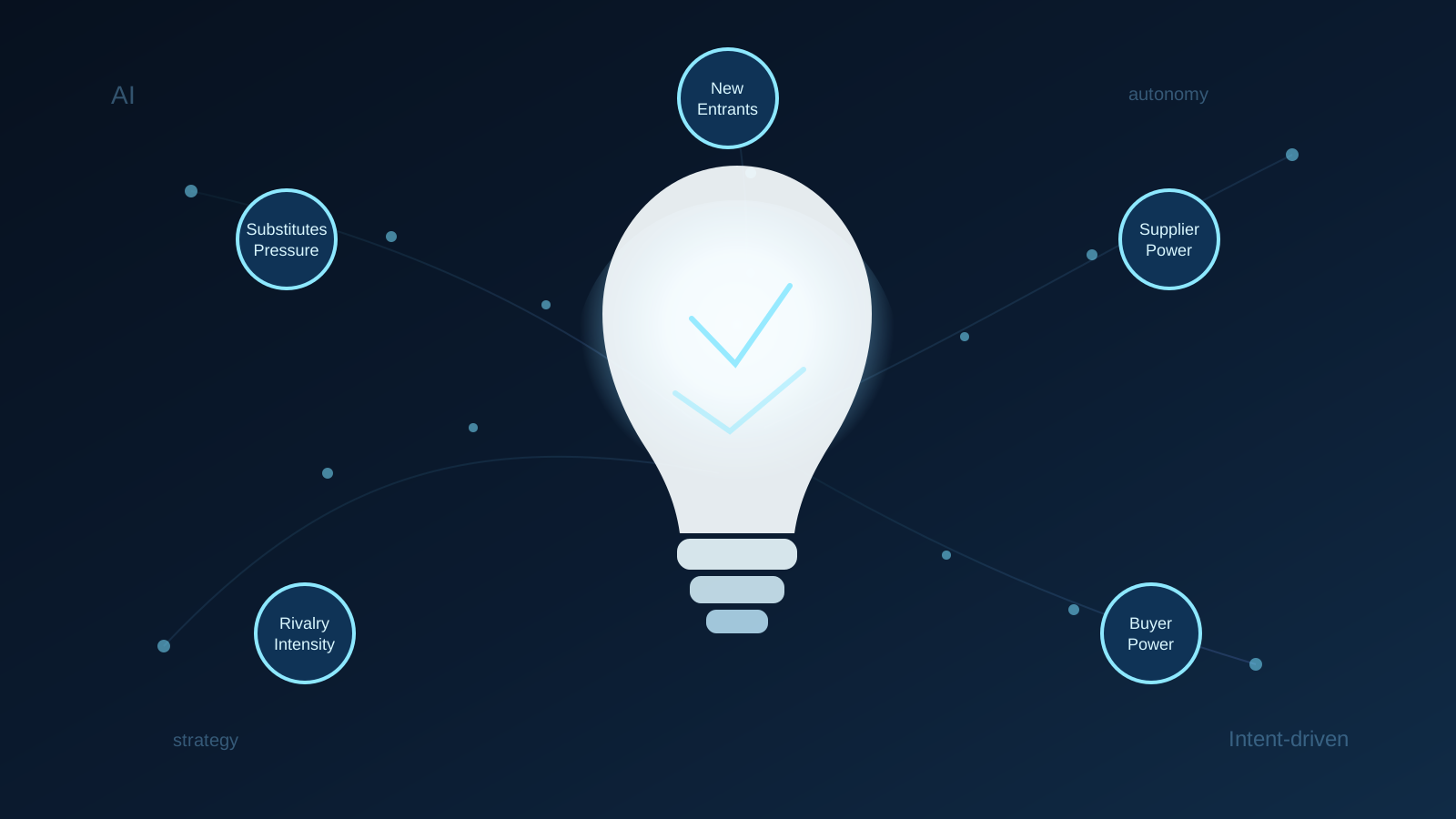
Porter’s Five Forces After AI: Why Intent-Driven Organizations Compete Differently
Every few years, somebody says an old strategy framework is now dead. Usually it is not dead. Usually the environment changed, and people do not want to do the slower thinking anymore.
That is how I see Porter’s Five Forces in the age of AI. The model is still useful. Maybe even more useful. But you cannot apply it in the lazy textbook way, because AI changes how each force behaves, how fast it moves, and what kind of organization can answer it in time.
The other part of the story is internal. If markets move faster, a rigid company reacts too slowly. This is where the intent-driven organization becomes important. In simple words, leadership gives clear intent, boundaries, and priorities, while people closer to the work can decide and move without waiting for every approval.
AI changes competition outside the firm. Intent-driven leadership changes response speed inside the firm. You need both sides of that equation.
First, what AI really changes in competition
AI reduces the cost of many activities that were previously slow, expert-heavy, or expensive. Research, software development, customer support, content generation, forecasting, document review, and decision support can all move faster now. That means advantages built only on speed of analysis or volume of output become weaker.
But AI also creates new concentration points. Cloud platforms, foundation model providers, chip makers, proprietary data owners, and trusted distribution channels become more important. So AI does not simply democratize competition. It opens some doors and closes others.
This is exactly why Porter still matters. The five forces help us see where pressure is shifting instead of just repeating that “AI changes everything.”
1. Threat of new entrants: lower entry cost, but not lower trust requirements
AI lowers some entry barriers very clearly. A smaller company can now build software faster, automate service workflows earlier, and create market-facing material with much less overhead. In many sectors, that means new entrants can look more capable than their size would suggest.
So yes, the threat of new entrants increases.
But not equally everywhere. In regulated sectors, high-trust services, and operationally complex businesses, AI does not remove the need for credibility, quality systems, customer intimacy, and domain judgment. A startup can generate polished output. It still may not earn the right to be believed.
This is where intent-driven organizations gain an edge over traditional incumbents. They preserve the trust, experience, and customer base of an established player, but they react with more speed because decision-making is less trapped in layers.
2. Supplier power: stronger than many leaders admit
One mistake I see often is this: executives talk about AI as if it gives them freedom, while in practice they are becoming dependent on a new supplier stack.
Model providers, cloud vendors, infrastructure firms, specialist data sources, and even a few key integration partners now hold meaningful leverage. Pricing can change. Terms of use can change. Model behavior can change. Availability and performance can change. If your new workflow depends on an external AI stack, supplier power is not theoretical anymore.
For many firms, AI actually increases supplier power before it reduces it.
An intent-driven organization handles this better because teams closer to the products and operations can detect vendor risk early, run alternatives, and redesign workflows without waiting for top-down rescue. Leadership still sets the architectural principles, but not every adaptive move needs to climb the hierarchy.
3. Buyer power: customers can compare faster and switch sooner
AI gives buyers more power too. They can gather information faster, compare offers faster, and use AI tools to evaluate alternatives with less effort. In B2B settings, procurement and customer teams can arrive better prepared. In consumer settings, switching friction may drop because comparison and onboarding become easier.
Also, when AI makes baseline service quality easier to copy, buyers become less impressed by generic efficiency claims. They expect faster response, better personalization, and more transparency almost by default.
This changes the game. If your value proposition is only “we do the same thing a bit faster,” buyer power will eat your margin. You need clearer differentiation: expertise, trust, outcomes, integration, accountability, or a better operating model.
Intent-driven organizations are useful here because they can respond to customer signals earlier. Teams do not only escalate problems upward. They can adapt the offer, refine the workflow, and remove friction while still staying aligned with strategic intent.
4. Threat of substitutes: this force grows quietly, then suddenly
AI creates substitutes in a very uncomfortable way. A product is not always replaced by a direct competitor. Sometimes it is replaced by a workflow, a copilot, a self-service assistant, or a different way of solving the same job-to-be-done.
A consulting deliverable can be partly substituted by AI-enabled internal analysis. A first-line support service can be substituted by a well-designed assistant. Administrative services can be substituted by automation plus human exception handling.
This is why leaders should not ask only, “Who are our competitors?” They should ask, “What other mechanism can now solve the customer’s problem acceptably enough?” That is a substitutes question, and AI makes it more dangerous.
The best defense is not panic. It is redesign. Intent-driven organizations are better at redesign because they allow local experimentation. The people who see the substitute emerging can test a response before the substitute becomes the new norm.
5. Rivalry among existing competitors: speed becomes a weapon
Rivalry intensifies because AI accelerates cycles of imitation, response, and optimization. Competitors can launch features faster, produce campaigns faster, analyze your pricing faster, and improve their internal productivity faster. When many players have access to similar general-purpose AI, the advantage moves away from mere tool access and toward execution discipline.
So rivalry is not only stronger. It is faster.
And here, command-and-control organizations struggle badly. If every response needs to move through committees, the market learns quicker than the company does. The firm becomes informed but slow, which is maybe the worst combination.
An intent-driven company does something different. It aligns people around purpose, constraints, and strategic priorities, then gives them room to act. That does not mean chaos. It means disciplined decentralization. In a higher-velocity market, that is often the difference between adaptation and drift.
So what is an intent-driven organization in this context?
The phrase can sound abstract, but the practical meaning is simple enough. Leadership does not try to make every decision. Leadership creates shared clarity: what matters most, what risks are unacceptable, what trade-offs are acceptable, and what outcomes teams are responsible for.
Then the organization moves authority closer to knowledge.
This matters under AI conditions because AI compresses time. If analysis, generation, and workflow automation become faster, the bottleneck becomes human coordination. Many organizations will discover that their real problem was never lack of ideas. It was lack of decision flow.
What leaders should do now
| Force | How AI changes it | What an intent-driven organization does |
|---|---|---|
| New entrants | Lowers cost of entry and speed of initial capability building | Uses incumbent trust and domain depth, but responds with startup-like speed |
| Supplier power | Raises dependence on model, cloud, chip, and data suppliers | Monitors dependency risk early and adapts architecture faster |
| Buyer power | Increases transparency, comparison, and switching readiness | Lets teams remove friction and refine value fast without waiting for hierarchy |
| Substitutes | Creates alternate workflows, copilots, and automation paths | Runs local experiments and redesigns services before substitution hardens |
| Rivalry | Speeds up imitation, optimization, and market response cycles | Competes on execution tempo, not only ideas or reporting depth |
If I had to reduce the practical advice to three points, it would be these:
- Reassess your industry structure with AI explicitly in the picture. Do not discuss AI only as a tool. Discuss how it shifts leverage between entrants, suppliers, buyers, substitutes, and rivals.
- Map where your organization slows down. In many firms, the strategic issue is not lack of technology but too much decision latency.
- Strengthen clarity before autonomy. Intent-driven execution works only when teams understand purpose, boundaries, and consequences.
Conclusion
Porter’s Five Forces still help us ask the right market questions. AI just changes the answers. Some barriers fall. Some dependencies rise. Rivalry speeds up. Substitutes appear from strange angles. Buyers become more informed. Entrants become more credible faster.
But the external picture is only half the story. The firms that benefit most from AI will not always be the ones with the biggest model budget. Often they will be the ones that combine strategic clarity with distributed judgment.
That is why I do not see AI and the intent-driven organization as two separate topics. One changes the pressure. The other changes the response capacity.
And in strategy, that difference matters a lot.
