The New IVDR Classification Guide Is Here: A Visual Decision Pathway for IVD Manufacturers
In September 2026 the Medical Device Coordination Group published revision 5 of MDCG 2020-16, the guidance that explains how to classify in vitro diagnostic medical devices under Regulation (EU) 2017/746, better known as the IVDR. For manufacturers, quality managers and regulatory affairs directors, this document is not a formality. The class assigned to an IVD determines whether a notified body is involved, how much clinical evidence is required, what post-market surveillance looks like, and how long the route to the EU market will take.
Yet classification is still where many submissions stall. The rules in Annex VIII are short. Their application is not. A small change in intended purpose can move a device from Class A to Class C. A near-patient version of the same assay can carry a different class than its laboratory twin. A control without an assigned value is treated differently from one with a value. These distinctions matter, and they are easy to miss if the classification exercise is treated as a quick checkbox.
The class of an IVD is not a label you add at the end of development. It is the lens through which the entire conformity strategy is built.
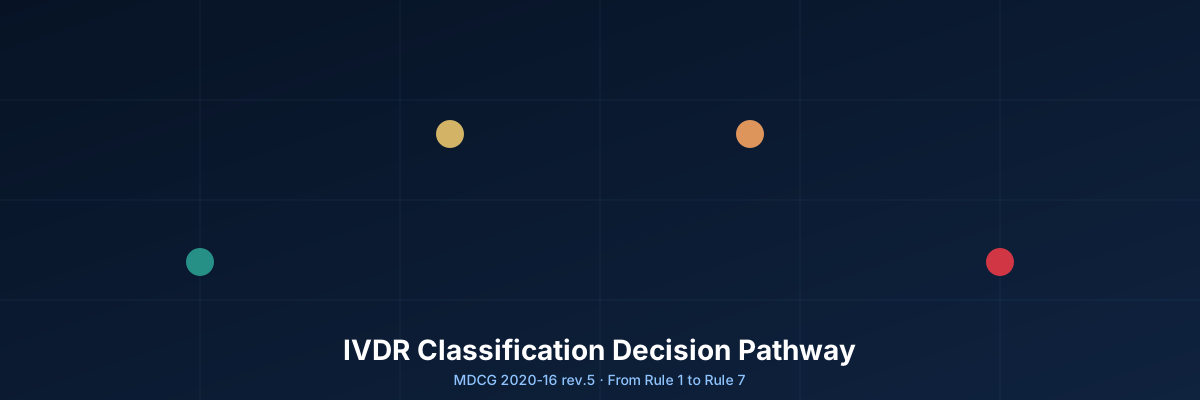
This article offers a different way to read MDCG 2020-16 rev.5: as a pathway. The interactive diagram below walks through Rules 1 to 7 in the order a manufacturer should ask them. Hover over each node to see the rule text. Answer the diamond questions in sequence. The first "Yes" tells you the class. If every answer is "No", Rule 6 catches the remainder as Class B.

Why classification comes before everything else
Under the IVDR, classification is the first gate because it fixes the rest of the conformity route. Class A devices can generally self-certify under Annex VIII unless they are sterile, have a measuring function, or are sold as sterile or reusable surgical instruments. Class B devices need a notified body for at least the quality management system and post-market surveillance elements. Class C and D devices require full notified-body involvement, with Class D carrying the heaviest evidence burden because of their direct impact on blood, transplant and high-risk infectious disease safety.
Getting the class wrong therefore has expensive consequences. A manufacturer that self-certifies a device that should be Class C risks non-conformity, market withdrawal and damaged credibility with competent authorities. A manufacturer that over-classifies a Class B device as Class C adds unnecessary notified-body cost and clinical evidence work. The guidance exists to reduce both errors, but only if it is read carefully.
How to use the pathway
The diagram above is not a legal instrument. It is a structured reading of Annex VIII as clarified by MDCG 2020-16 rev.5. The recommended sequence is:
- Write down the intended purpose of the device exactly as the manufacturer states it, including the specimen type, the analyte, the clinical question and the user.
- Work through Rules 1 to 7 in order. The rules are hierarchical in practice: Rule 1 captures the highest-risk transmissible-agent scenarios, Rule 2 captures blood grouping, Rule 3 captures a broad set of high-risk diagnostic contexts, and so on.
- Stop at the first rule that applies. An IVD can fall under more than one rule in theory, but the guidance expects you to assign the highest applicable class.
- Document the rationale. Notified bodies and competent authorities will ask why a particular rule was chosen and why others were excluded.
With that process in mind, here is what each rule actually does.
Rule 1: transmissible agents and their consequences
Rule 1 is split into three indents, and each indent has a different class outcome. The first indent covers devices that detect the presence of, or exposure to, a transmissible agent in blood, blood components, cells, tissues or organs, or any of their derivatives, where the purpose is to assess suitability for transfusion, transplantation or cell administration. This is the highest-risk IVD scenario under the IVDR: an erroneous result can directly compromise the safety of a recipient. The outcome is Class D.
The second indent covers devices intended to detect the presence of, or exposure to, a transmissible agent that causes a life-threatening disease with a high or suspected high risk of propagation. Think of assays for Ebola virus, SARS-CoV-2 in certain high-risk settings, or other agents where a wrong negative result could allow rapid spread. This also leads to Class D.
The third indent is more specific. It covers devices intended for determining the infectious load of a life-threatening disease where monitoring is critical in the process of patient management. HIV viral load assays are the classic example. Because the device guides treatment decisions in an already infected patient, the risk is high but not identical to the transfusion or public-health propagation scenarios above. The outcome is Class C.
Rule 2: blood grouping
Rule 2 looks simple on the surface: devices intended for blood grouping. The detail is in the examples. Most blood-grouping devices, including those for extended phenotyping such as Kell or Duffy, are Class C. However, ABO and Rh(D) grouping, and phenotyping where the result is used to determine transfusion compatibility, are treated as Class D because an ABO mismatch can be fatal. MDCG 2020-16 rev.5 reminds manufacturers to look at the clinical use, not just the analyte.
Rule 3: the broad high-risk bucket
Rule 3 is the longest rule because it gathers many high-risk scenarios that do not fit into Rules 1 or 2. It is worth reading in full, but the common themes are:
- Sexually transmitted agents (Rule 3a) — Class C.
- Infectious agents in cerebrospinal fluid or blood without high propagation risk (Rule 3b) — Class C.
- Infectious agents where an erroneous result creates a significant risk of death or severe disability for the patient, foetus, embryo or offspring (Rule 3c) — Class C.
- Pre-natal screening of women to determine immune status towards transmissible agents (Rule 3d) — Class C.
- Determination of infective disease status or immune status where an erroneous result would lead to a patient-management decision resulting in a life-threatening situation (Rule 3e) — Class C.
- Companion diagnostics (Rule 3f) — generally Class C, with the companion-diagnostic relationship assessed per intended purpose.
- Disease staging where an erroneous result would lead to a life-threatening patient-management decision (Rule 3g) — Class C.
- Screening, typing or predisposition testing for cancer (Rule 3h) — Class C.
- Human genetic testing (Rule 3i) — Class C.
- Pharmacogenetic testing with critical characteristics (Rule 3j) — Class C.
- Testing of congenital disorders in embryos or foetuses when the disorder is life-threatening or has severe disability impact (Rule 3k) — Class C.
- Determination of risk of trisomies (Rule 3l) — Class C.
- Diagnostics for patients with life-threatening disease or disease progression where monitoring is critical (Rule 3m) — Class C.
The pattern across Rule 3 is clear: the IVDR elevates devices that inform decisions about life-threatening conditions, reproduction, cancer, genetics or the selection of high-risk therapies.
Rule 4: self-testing
Rule 4 states that devices intended for self-testing are classified as Class C, unless they fall under Rule 1 second indent, in which case they remain Class D. The rationale is that lay users cannot be expected to interpret complex results or manage pre-analytical variables in the same way a laboratory professional can. A pregnancy test or a glucose meter for home use is therefore treated more strictly than the same assay performed in a clinical laboratory, even if the underlying technology is identical.
The guidance also clarifies that near-patient testing is classified in its own right. A device used at the point of care by a healthcare professional is not automatically a self-test, but the intended purpose and user environment must be explicit in the technical documentation.
Rule 5: general laboratory products, instruments and receptacles
Rule 5 captures the lower-risk end of the IVD ecosystem. It applies to:
- General laboratory products and accessories that possess no critical characteristics, such as plain buffers, washing solutions, general culture media and histological stains when intended by the manufacturer to be suitable for IVD procedures relating to a specific examination.
- Instruments intended specifically to be used for IVD procedures, provided the instrument itself does not perform the diagnostic assay.
- Specimen receptacles intended to preserve specimens for later examination.
These are generally Class A. The boundary case is an instrument that incorporates reagents, sensors or other critical components integral to the diagnostic measurement. In that situation the combined system is classified according to the assay it performs, not as a standalone Class A instrument.
Rule 6: the Class B default
Rule 6 is short and important: devices not covered by the above-mentioned classification rules are classified as Class B. This is the default class for many established IVDs that do not meet the high-risk criteria of Rules 1-4 and are not low-risk accessories or instruments under Rule 5. Many routine clinical chemistry assays, immunology tests and microbiology products fall here.
Rule 7: controls without assigned values
Rule 7 addresses controls without a quantitative or qualitative assigned value. These are Class B. Once a control has an assigned value, it is classified in the same class as the device it is intended to control. This distinction is important for manufacturers selling control panels: the presence or absence of an assigned value changes the class and therefore the conformity route.
Practical workflow for manufacturers
The pathway is a thinking aid, but the real work happens in the technical documentation. A robust classification workflow should include the following steps:
- Lock the intended purpose. Every classification argument starts here. Vague or aspirational claims make classification impossible to defend.
- Identify the specimen and the analyte. Blood, CSF, tissue, saliva or urine can change the applicable rule.
- Define the clinical consequence of an erroneous result. Would it cause death, severe disability, a life-threatening situation, or a wrong transfusion/transplant decision?
- Check for special categories. Is the device a companion diagnostic, a self-test, a genetic test, a cancer test, or a pre-natal screen?
- Walk through Rules 1-7 in order. The first applicable rule determines the class.
- Document the excluded rules. Explain why Rules 1, 2, 3, 4 and 5 do not apply if the device lands in Class B or A.
- Review at change. A new intended purpose, new claims, or a new user population can change the class.
Common classification mistakes
The MDCG guidance and notified-body experience highlight recurring errors. One is under-classifying based on familiarity: a device that was Class I under the old IVD Directive is not necessarily Class A under the IVDR. The risk-based logic of the IVDR is different and generally stricter. Another is ignoring the user: the same assay can be Class B in a laboratory, Class C as a self-test, and possibly Class C or D near-patient depending on claims. A third is missing the combination issue: when an instrument, reagent and software are sold together, the whole system is classified by the highest-risk component that performs the diagnostic function.
What changed in revision 5
MDCG 2020-16 rev.5, published in September 2026, revises several examples and clarifies the rationale behind Rule 7. Manufacturers who relied on earlier revisions should review the new wording for controls, solution packs, blood-gas analysers and calibrator classification. Even when the rule text itself has not changed, the examples often reveal how notified bodies are expected to interpret borderline cases.
Conclusion
IVDR classification is not an afterthought. It shapes the entire conformity strategy, the clinical evidence plan, the quality-management-system scope and the post-market surveillance obligations. MDCG 2020-16 rev.5 gives manufacturers a clearer map than previous revisions, but the map still has to be read with the specific intended purpose in hand. The pathway in this article is a practical starting point. Use it to ask the right questions in the right order, then build the technical documentation around the answer.
For teams preparing an IVDR submission, the goal is simple: classify correctly before you design the rest of the dossier. Everything else flows from there.
