The Silent Revolution Behind HTTP 402: Why x402 Could Rewire Agentic Commerce and Europe’s Payment Future
Some technologies do not arrive with fireworks. They return quietly, almost embarrassingly, after decades of neglect.
HTTP status code 402 Payment Required is one of those cases. Reserved in the early days of the web for a future payment use case, it mostly became trivia. Developers knew it existed. Almost nobody built real internet economics around it.
That may be changing.
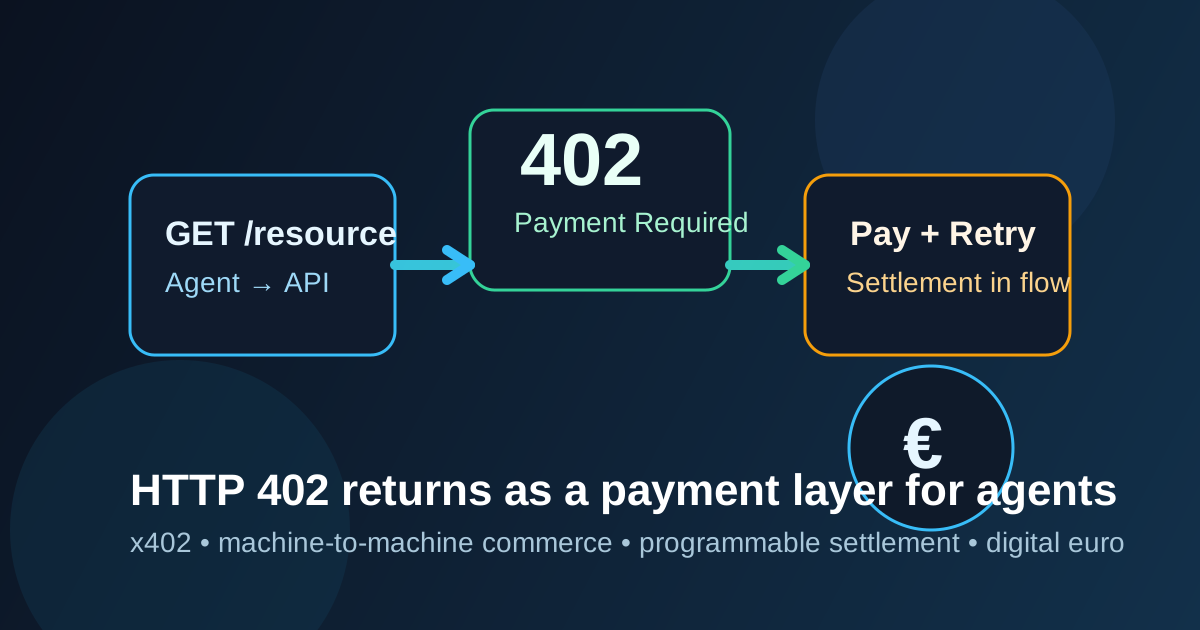
The x402 initiative is trying to turn that dormant status code into a real payment primitive for the internet. The idea is very simple: a server can respond with 402 Payment Required, tell the client what payment is needed, receive payment, and then let the client retry the request. According to the x402 project site, this makes payment part of the normal HTTP flow rather than a separate account, subscription, or credit-preload ritual.
If x402 matures, the biggest shift is not that we get yet another crypto payment rail. The real shift is that payment becomes callable infrastructure for software, agents, and machines.
Why this matters now
The timing is not random. We are moving into a world where software does not just display information. It plans, negotiates, retrieves, books, buys, settles, and chains together services across many providers.
That creates a very old problem in a new form: how does a machine pay another machine, instantly, safely, and without human checkout friction every single time?
Traditional payment processing was never designed for that world. Cards, merchant accounts, subscriptions, invoicing, and prepaid credits work reasonably well for people and companies. They work badly for high-frequency agentic workflows that may need to buy a data feed, a model call, a compliance check, extra storage, a mapping request, or compute capacity in the middle of an execution chain.
This is where the broader payments story matters. Coinbase is directly in the x402 story: the original GitHub repository sits under Coinbase and now explicitly notes that the project has moved under the independent x402 Foundation. Stripe is part of the larger story in a different way. Stripe trained the software industry to expect payments as developer infrastructure rather than as a painful banking ceremony. x402 pushes that logic one step further: from developer-friendly payments to machine-native payments inside the protocol itself.
What x402 actually changes
On the x402 site, the canonical flow is short and clean:
- A client or agent sends an HTTP request.
- The server responds with 402 Payment Required and payment instructions.
- The client pays and retries.
That sounds almost too neat, but the elegance is the point. Payment becomes part of the web contract itself.
The V2 launch note adds important depth. x402 is no longer only about one-off exact payments. The V2 update says the protocol now includes:
- wallet-based identity and reusable access patterns, so repeated calls do not need to repay from scratch every time,
- automatic discovery so facilitators can index x402-enabled services dynamically,
- dynamic payTo routing for marketplaces and multi-tenant services,
- support for more chains and fiat-oriented compatibility via CAIP standards,
- and a modular SDK and extensions model so the protocol can evolve without constant forking.
The same V2 writeup also claims x402 processed over 100 million payments across APIs, apps, and AI agents within its first months. That is their claim, not an independently audited market statistic, but even as a directional signal it is striking.
Why agentic workflows care more than humans do
Humans tolerate checkout friction because we have no choice. Machines do not tolerate it well because friction destroys workflow economics.
Imagine an enterprise agent responsible for producing a market-entry assessment. It may need to call six external APIs, pay for a premium legal extract, purchase a geospatial dataset, run additional model inference from a specialist vendor, and commission identity verification on one external party. In the current world, that usually breaks in one of three ways:
- the workflow is impossible because every service requires a separate account and contract,
- the company prepays credits and wastes budget on idle balances,
- or humans are pulled back into the loop every time spending needs approval or a payment method must be stored.
x402 points to a different operating model. The agent hits an endpoint, gets a price and payment requirements, pays for exactly that step, and continues. Not a monthly subscription. Not a manually provisioned vendor account. Not a PDF invoice that arrives three weeks later. Just settlement inside the workflow.
That is why even people who do not care about crypto should care about the architecture. Once workflow economics start rewarding machine-native purchasing, many organisations will adopt parts of this stack indirectly simply because the alternatives are slower, clumsier, and more expensive to orchestrate.
x402 versus traditional payment processing
| Dimension | Traditional payment stack | x402-style machine-native flow |
|---|---|---|
| Onboarding | Accounts, KYC, billing setup, stored payment methods | Payment instructions returned in-band with the HTTP request |
| Commercial model | Subscriptions, invoices, prepaid credits, card charges | Usage-level settlement per request or reusable paid session |
| Best suited for | Human customers and standard SaaS billing | Agents, APIs, marketplaces, and machine-to-machine commerce |
| Workflow latency | High when a new provider or approval step is needed | Potentially low if trust, verification, and settlement are streamlined |
| Integration logic | Separate billing stack plus API authentication stack | Payment logic lives closer to the request-response contract |
This does not mean traditional processors disappear. Most enterprise commerce, consumer commerce, payroll, tax handling, and regulated banking workflows will stay hybrid for a long time. But it does mean a new payment layer may emerge underneath them for software-driven transactions.
The strategic implication: payment becomes a software primitive
That is the deeper change. We are used to thinking of payments as a business function. In agentic systems, payments start to look more like infrastructure.
That affects architecture decisions immediately:
- APIs can monetize at much smaller units.
- Autonomous workflows can buy external capabilities just-in-time.
- Marketplaces can route value dynamically to the right recipient.
- Access control, identity, and payment can converge around wallet-backed or programmable session models.
- Settlement becomes something product teams and platform engineers must design for, not only finance teams.
If that sounds niche, it will not stay niche for long. Once agents are expected to operate across supplier ecosystems, the absence of a native payment layer becomes an execution bottleneck.
Europe should be worried — and ambitious
This is the part European policymakers and institutions should not sleep through.
The EU keeps discussing digital sovereignty, industrial policy, strategic autonomy, and the digital euro. Fine. But the digital euro conversation is still too often framed around retail payments, financial stability, and public-money access for humans. Those matter. They are not enough.
The EU needs to wake up and explicitly include machine-to-machine commerce, agentic purchasing, and programmable settlement in the digital euro agenda. And to be clear, this is not about building a sealed-off European payment island. The real issue is the overall future payment system. Europe should not miss that train again.
If x402-style machine-native payments mature first elsewhere, Europe risks repeating an old pattern from digital infrastructure and consumer payments: depending on rails shaped by others, much as it long depended on networks like Visa and Mastercard. We will tell ourselves we are protecting the market while quietly accepting dependency on payment rails, technical standards, and settlement intermediaries defined elsewhere.
That would be a strategic mistake.
A serious European response would ask harder questions:
- Can a future digital euro support programmable, policy-aware settlement for machines as well as people?
- Can European APIs and enterprise systems expose payment requirements in standard ways that align with open internet models?
- Can compliance, auditability, and identity be designed into machine payments without crushing usability?
- Can the EU foster open payment standards rather than just regulating their consequences after the market forms elsewhere?
If Europe misses this layer, it will not only miss a fintech trend. It will miss part of the operating system for agentic commerce.
The skepticism is healthy — but it should be precise
There are fair objections here.
Not every enterprise wants blockchain-linked settlement in production flows. Many buyers will worry about volatility, legal classification, accounting treatment, sanctions exposure, and operational trust. Security teams will worry about wallets and payment authorization. Regulators will worry, often for good reason, about governance and abuse.
Those concerns are real. But they are not the same as saying the model does not matter.
The more precise view is this: the first successful versions of machine-native payments may arrive in mixed form. Some will lean on stablecoins. Some may connect to fiat-oriented facilitators. Some will sit behind abstractions that hide the underlying rails from end users completely. That is consistent with the x402 repository’s own ambition to support both crypto and fiat networks over time.
So even non-crypto believers may still adopt the architecture indirectly. They may not choose the ideology. They may choose the workflow performance.
My take
I think x402 is one of those signals that looks small until you place it in the right frame.
In isolation, it is “just” a revived HTTP status code and a cleaner payment handshake. In context, it may be the start of a much bigger shift: the return of the web’s own protocol surface as a place where value moves, not just information.
Coinbase is visibly helping drive that revival. Stripe’s legacy is visible in the broader developer expectation that payments should be programmable and product-native. Put those forces together with agents, APIs, and real-time workflow economics, and the forgotten 402 suddenly stops looking forgotten.
It starts looking early.
Conclusion
The silent revolution behind HTTP 402 is not about nostalgia. It is about whether the internet gets a payment layer that software can actually use at machine speed.
If x402 or something close to it wins, agentic workflows will become easier to compose, smaller services will become easier to monetize, and the boundary between access control and settlement will start to blur.
And if Europe wants a meaningful digital euro strategy, it needs to join that conversation now — not after the next payment layer is already imported.
