Google Open-Sources agents-cli: Why Architects and Engineers Should Pay Attention
Google has now open-sourced agents-cli, with documentation published at google.github.io/agents-cli. On the surface, it looks like another developer tool in the already crowded agent stack. That would be the lazy reading.
The more interesting reading is this: Google is trying to make agent engineering more operational, more repeatable, and more infrastructure-aware. That matters because most teams still treat agents like a demo problem, while production systems fail on the boring parts: scaffolding, evaluation discipline, deployment consistency, observability, and governance.
This article is based on Google’s public agents-cli documentation and repository pages. The analysis below is original and written for software architects, platform engineers, and engineering leaders.
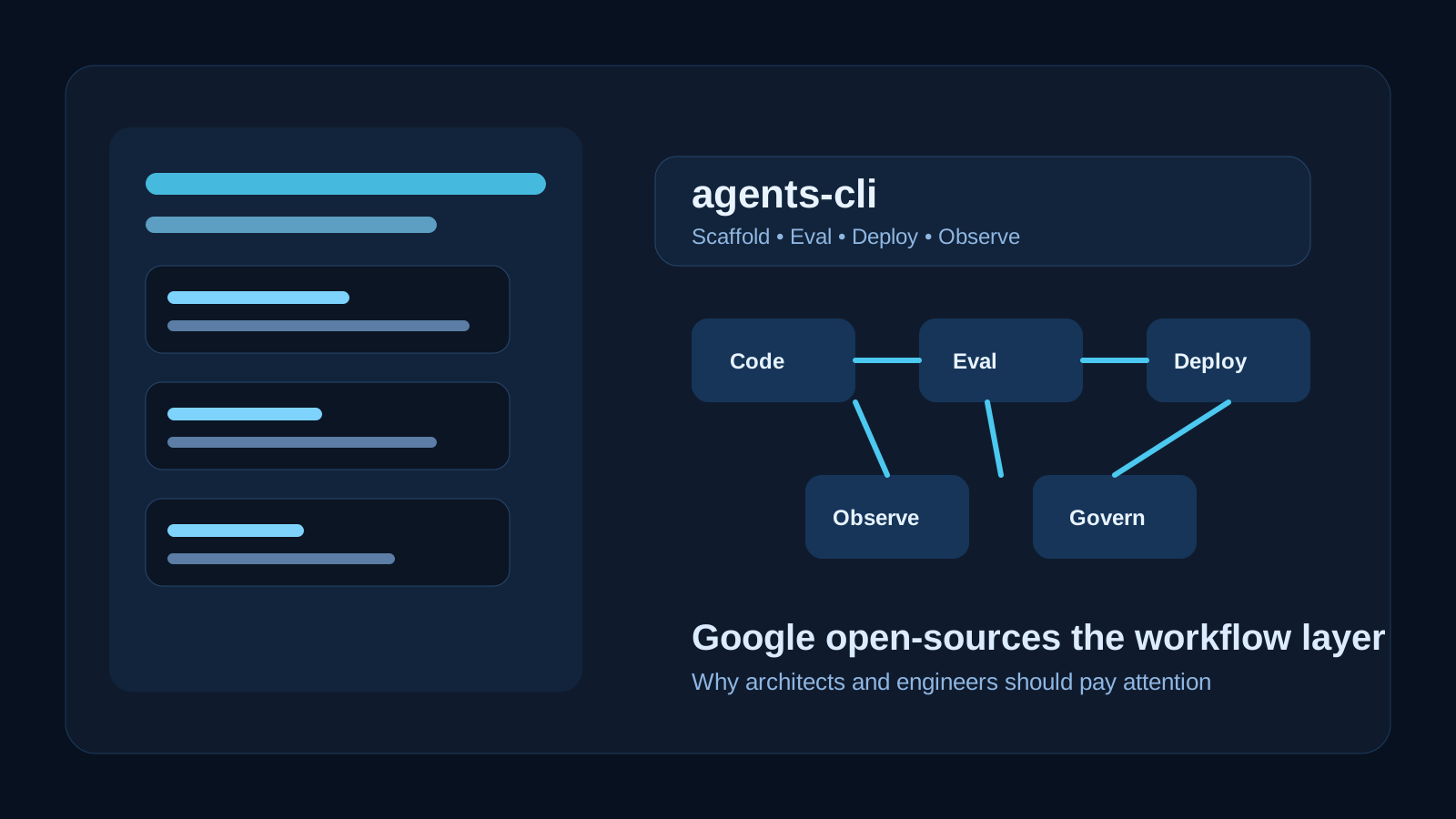
The headline is not just that Google released another CLI. The headline is that agent development is being packaged as an end-to-end engineering workflow: scaffold, run, evaluate, deploy, observe, and publish.
What agents-cli actually is
Based on the public documentation, agents-cli is a command-line tool plus a skills layer designed to work with coding assistants such as Gemini CLI, Claude Code, Codex, and others. It is positioned as the glue between a coding agent and Google’s agent stack, especially the Agent Development Kit (ADK), evaluation workflows, deployment targets, and enterprise registration paths.
That distinction matters. agents-cli is not a coding agent itself. It is an enablement layer that teaches coding agents how to scaffold projects, run evaluations, deploy to Google Cloud, wire observability, and handle the wider lifecycle around agents.
Why the open-source move matters
When a vendor open-sources a tool like this, the real signal is usually not altruism. It is ecosystem strategy. Google wants more builders using its agent stack, more repeatable deployment patterns landing on Google Cloud, and fewer teams getting stuck in bespoke one-off implementations.
For architects, that is useful. Even if your team does not standardize on Google’s entire stack, an open workflow tool gives you a clearer reference model for how a serious vendor thinks agent delivery should work in practice.
It also lowers the friction for evaluation. Teams can inspect how the workflow is framed, where the opinionated commands are, and what operational assumptions are being baked into the lifecycle.
The practical architecture signal
The strongest signal in agents-cli is not any single command. It is the shape of the workflow it implies.
- agent projects should be scaffolded from a known structure rather than improvised from scratch
- evaluation should be a first-class activity, not a late-stage afterthought
- deployment paths should be codified for Cloud Run, GKE, and managed runtime environments
- observability belongs in the default toolkit
- publishing and enterprise registration are treated as part of the lifecycle, not a side quest
That is a healthier operating model than what many teams still do today, which is to prototype an agent in a notebook, bolt on a few tools, and hope it somehow matures into a service.
What engineers should like about it
There are a few reasons this is genuinely useful for engineering teams.
- It reduces lifecycle fragmentation. The public command set spans setup, login, scaffold, run, eval, deploy, infrastructure, and publish workflows. Even if the implementation is opinionated, the lifecycle is coherent.
- It treats eval as engineering, not marketing. The documentation explicitly calls out eval methods, metrics, evalsets, LLM-as-judge approaches, and comparison workflows. That is a strong sign of maturity.
- It acknowledges platform reality. Enterprise agents do not stop at model prompts. They need CI/CD, secrets, infrastructure provisioning, and runtime operations.
- It works with multiple coding agents. Google is being pragmatic here. Instead of forcing one developer interface, it is trying to meet engineers inside the tools they already use.
What architects should be cautious about
I would not read this as proof that the hard part of agent systems is now solved. It is not.
- Workflow standardization is not system reliability. A better scaffold does not automatically fix weak tool design, poor grounding, or unsafe action patterns.
- Cloud alignment cuts both ways. If your architecture is already moving toward Google Cloud, this is helpful. If portability is a hard requirement, you should inspect where the workflow becomes platform-sticky.
- Open source here still looks layered and strategic. The repository publicly exposes the workflow, docs, and contribution paths, but the published note also makes clear that the CLI is distributed as a pre-built wheel. That is not the same thing as a fully transparent source-first project.
- The enterprise story still depends on operational discipline. A CLI can make good practices easier, but it cannot force a team to define eval gates, ownership boundaries, rollback criteria, or governance thresholds.
What this means for platform teams
If you are building an internal AI platform, agents-cli is worth studying even if you never adopt it directly. It offers a concrete checklist of what a modern agent platform now needs to support:
- standardized scaffolding
- local run and test loops
- repeatable evaluation workflows
- deployment automation
- observability hooks
- infrastructure templates
- an opinionated path from experiment to governed service
In other words, the market is moving away from “prompt engineering as craftsmanship” and toward “agent delivery as platform engineering.” I think that shift is overdue.
My read on the strategic timing
The timing also makes sense. Agent frameworks are multiplying. Coding agents are becoming default developer companions. Enterprises are asking for real deployment patterns instead of toy demos. In that environment, the winning move is not only to offer models. It is to capture the workflow around the models.
That is what agents-cli is trying to do. It gives Google a way to shape how teams think about agent development, while staying compatible with the coding assistants those teams already prefer.
Conclusion
Google open-sourcing agents-cli matters less as a branding event and more as an architectural signal. It says that the agent stack is maturing into a full delivery discipline, with scaffolding, evaluation, deployment, and observability treated as default concerns.
For engineers, that means less time reinventing lifecycle plumbing. For architects, it means one more strong sign that agent systems should now be designed as governed software delivery pipelines, not just clever model wrappers.
That is the real story here.
