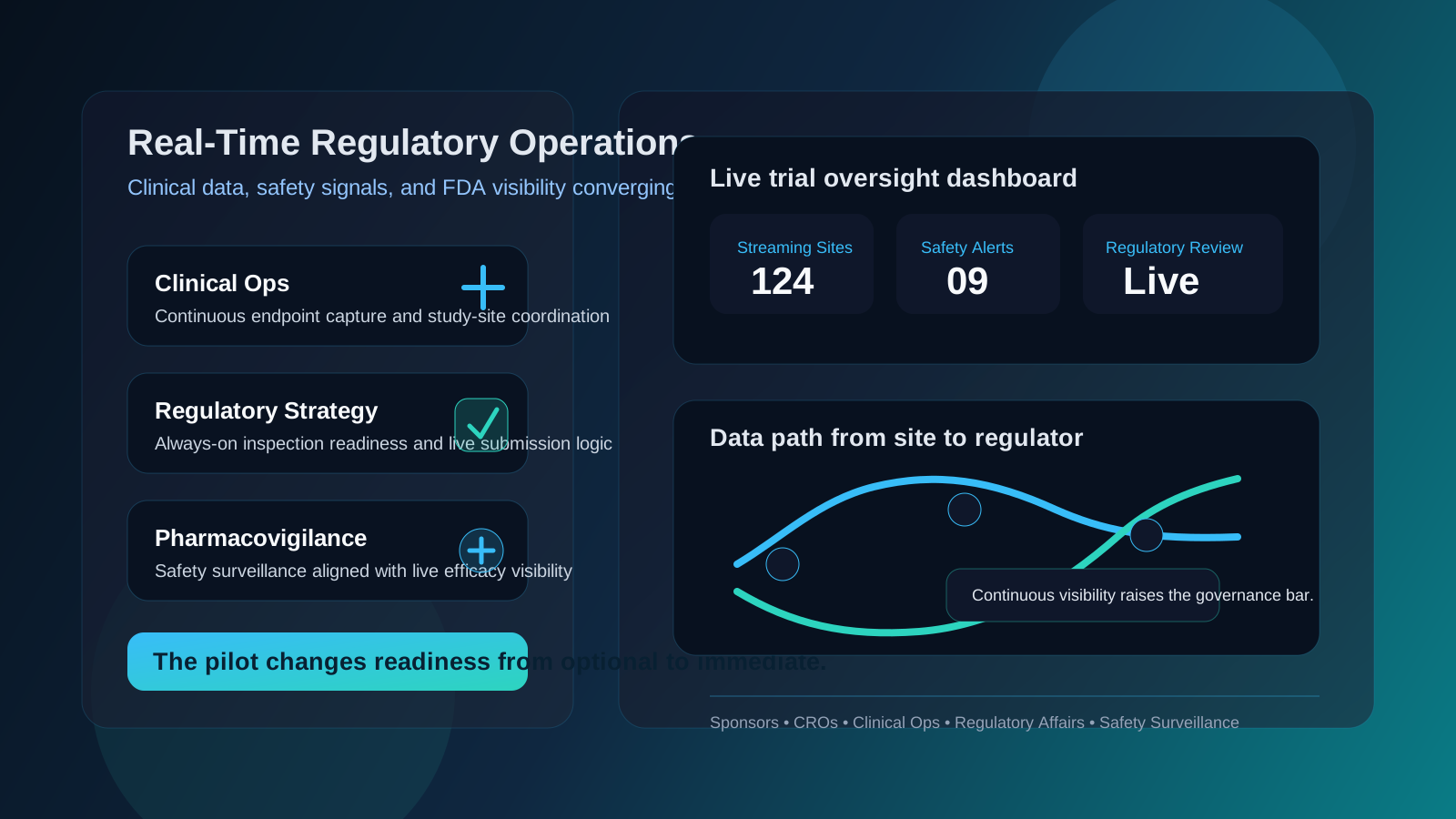
Why the FDA's Real-Time Trial Signal Changes Clinical Operations Now
Commissioner Marty Makary's op-ed is more than a regulatory signal. It is attached to something that is already operational enough to matter. The FDA has named two proof-of-concept efforts under this model: AstraZeneca's TRAVERSE study in mantle cell lymphoma and Amgen's STREAM-SCLC study in small cell lung carcinoma. It also says FDA scientists have already received and validated real-time signals from the AstraZeneca trial through Paradigm Health. That moves this story out of the realm of vague future intent.
There is another important detail that should not be missed: this is explicitly framed as an AI-enabled optimization of early-phase clinical trials, not a broad announcement that all phases of clinical development are suddenly moving to live regulatory streaming. The FDA's request for information is focused on early-phase bottlenecks, the comment window closes on 29 May 2026, final selection criteria are expected in July, and pilot selections are expected in August.
That makes the news more concrete and, frankly, more interesting. The technical feasibility is no longer hypothetical. The immediate question is operational: what does it mean for sponsors, CROs, and regulatory teams when an agency is no longer waiting only for static reporting packages, but is starting to validate the mechanisms for real-time visibility into safety signals and endpoints as trials progress?
The biggest shift here is not just speed. It is that AI-enabled, regulator-visible trial operations are moving from concept into practice, starting in early-phase development.
Why this matters beyond speed-to-market rhetoric
Makary's framing around reducing the old lag between data generation and regulatory decision-making is fair and important. Clinical development has tolerated too much dead time for too long. If better data pipelines, AI-assisted signal handling, and more live oversight can reduce that lag, the benefit to patients and sponsors could be substantial.
But the harder implication is architectural. Faster review is the visible benefit. Underneath it sits a requirement for stronger regulator-facing data governance, cleaner endpoint lineage, and more disciplined cross-functional coordination. Real-time visibility only works if the data and operating model deserve confidence.
That is why this announcement deserves more than a repost. It is not just a statement that the FDA wants modernisation. It is evidence that the agency is actively testing a new mode of supervision, starting where it believes the early-phase bottleneck is most painful.
The AI dimension is not optional background
One gap in many early reactions is that they talk about “real-time trials” while barely mentioning AI. That misses the point. The FDA itself is framing this around AI-enabled optimization, and that matters because AI is not decorative here. It is part of the mechanism that makes more dynamic signal validation and faster operational interpretation possible.
That does not mean AI replaces clinical judgment or regulatory review. It means the operating environment becomes more data-rich, more continuously interpretable, and more dependent on systems that can surface meaningful patterns without waiting for the old reporting cadence.
For sponsors and CROs, that raises the bar. AI capability is no longer only a productivity story. It becomes part of trial readiness, oversight design, and regulatory credibility.
Clinical operations will feel this first
Because the scope is early-phase, clinical operations is the first function likely to feel the impact. Study oversight still often assumes reporting cycles, reconciliation lag, vendor handoffs, and delayed interpretation windows. If regulators can view signals more dynamically, that operating rhythm starts to look outdated very quickly.
Query resolution, source-to-EDC timing, endpoint traceability, protocol deviation handling, site-level variance, and operational latency all become more exposed. That does not mean the FDA is suddenly watching every data point in every trial. It means the organisations entering this model need to act as if the quality of their live operational discipline matters much more than before.
That is where the opportunity sits. Teams that can reduce latency and improve lineage may gain a real advantage. Teams that cannot may discover that a faster pathway rewards operational maturity, not just scientific promise.
Regulatory strategy becomes more system-aware
Regulatory affairs has traditionally been responsible for turning complex development work into coherent submissions and agency interactions. In a more real-time model, that role becomes more system-aware. The question is no longer only how to present data persuasively at formal milestones. It becomes how to define what is visible, what is decision-grade, how context is attached, and how anomalies are escalated in a more dynamic environment.
That is why this is not merely a tooling change. Governance models, data definitions, escalation pathways, and evidence-state logic become part of strategy. If the data environment is more visible, interpretive control has to be better designed.
Be careful not to overclaim the pharmacovigilance angle
There is a tempting extrapolation here into pharmacovigilance, ICSR timing, aggregate visibility, and safety-governance redesign. Those are legitimate analytical questions, but they are still extrapolations. The FDA announcement does not say that PV integration is part of the current initiative, and it does not claim that Phase 3 efficacy monitoring or broader safety-reporting redesign is imminent.
So the cleaner way to state it is this: if the FDA eventually succeeds in extending more continuous trial visibility beyond early phase, then pharmacovigilance and safety governance will become much more important design questions. But that is not the same as saying the current pilot already requires a PV operating-model rewrite.
I still think safety, medical monitoring, and regulatory governance will need closer coordination over time. I just would not attribute that point to the announcement itself. It is analysis, not reported fact.
Why named participants matter
The named participants make this announcement much more tangible. AstraZeneca and Amgen are not hypothetical examples. They are the identified sponsors in the proof-of-concept framing. MD Anderson, the University of Pennsylvania, and Paradigm Health show that this is already being anchored in a real ecosystem of study execution, data flow, and technical enablement.
There is also an important asymmetry worth being precise about. The FDA says it has already received and validated real-time signals from the AstraZeneca study. For Amgen's STREAM-SCLC, final site selection is still in process. That distinction matters, because it shows the framework is demonstrated, but not uniformly mature across every named effort yet.
Why manufacturers and CROs should care now
The practical message to sponsors, manufacturers, and CROs is straightforward: this is now concrete enough to plan around. The RFI is open, the deadline is near, the pilot timeline is defined, and the agency has shown that the technical model is not just aspirational. The window to get ahead of it is real.
For CROs, this should sharpen the question of what operational excellence means in the next cycle. It is no longer only about enrolment, monitoring, and milestone delivery. It is increasingly about whether the CRO can support a regulator-ready, AI-enabled, continuously interpretable data environment.
For sponsors, especially those without large-company infrastructure, the question is whether their current operating model can support that level of visibility and control. Some large pharma organisations may be better positioned structurally, but that is analysis, not destiny. Mid-tier sponsors can still prepare effectively if they treat readiness as an operating-model problem now rather than a technology procurement exercise later.
Conclusion
The real news is stronger than my original framing gave it credit for. The FDA is not merely floating an idea. It has named sponsors, a working technical pathway, a live RFI, an AI-centered framing, and a defined early-phase pilot timeline. That makes this one of the most meaningful regulatory-modernisation developments in years.
The right way to read it is with both discipline and ambition. Discipline, because the current scope is early phase and not every downstream implication should be presented as immediate fact. Ambition, because even at that scoped level, the shift is big: regulator-visible, AI-enabled, more continuous clinical evidence operations are no longer theoretical.
That is why this deserves more than enthusiasm. It deserves operational design. And for sponsors, CROs, and regulatory leaders who want to get ahead of the summer pilot, the relevant clock is already ticking.
