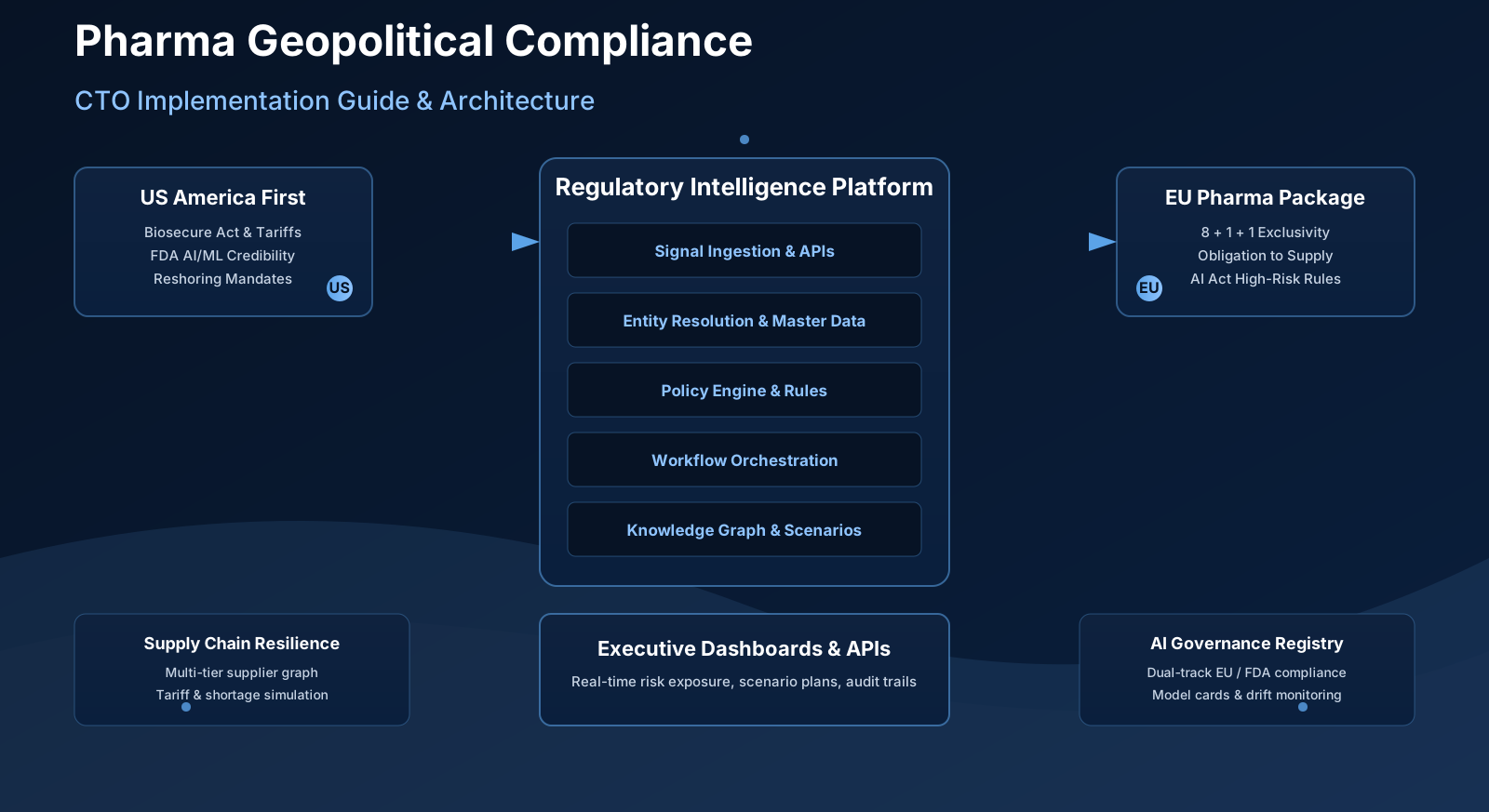
This is a deep-dive exploration from: Pharma's Geopolitical Chessboard: Navigating US America First and EU Pharma Package in 2025
Pharma Geopolitical Compliance: A CTO Implementation Guide
Executive Summary
The simultaneous tightening of US industrial policy and the EU Pharma Package has transformed regulatory compliance from a documentation exercise into a real-time systems-engineering problem. CTOs in pharmaceutical and life-sciences organisations must now build regulatory intelligence platforms that can ingest divergent legal signals, trace their impact on supply chains, exclusivity positions, and AI governance, and trigger actionable workflows across quality, regulatory affairs, manufacturing, and commercial teams.
This guide provides a concrete architecture, data model, API contract, vendor comparison, and 12-month implementation roadmap for a pharma geopolitical compliance platform. It is written for engineering leaders who need to make build-versus-buy decisions, allocate cloud and data budgets, and demonstrate measurable risk reduction to the board. Every pattern is grounded in published guidance from the FDA, EMA, European Commission, US Congress, and industry consortia.
The core insight is that compliance can no longer be treated as a series of disconnected projects. It must become a product: owned by a cross-functional team, funded as a strategic capability, and measured by business outcomes rather than document throughput. Companies that make this transition will gain a durable advantage in a regulatory environment that is becoming more fragmented, more data-driven, and more consequential for access to the world's two largest pharmaceutical markets.
1. The Technical Challenge: From Static Compliance to Dynamic Adaption
For the past two decades, multinational pharmaceutical companies could rely on a relatively stable global regulatory baseline. A single chemistry, manufacturing, and controls (CMC) strategy, one set of stability data, and a harmonised pharmacovigilance system were sufficient to serve both the US and EU markets profitably. That assumption collapsed in 2025. The US "America First" agenda introduced punitive tariff threats, reshoring mandates, and the Biosecure Act, while the EU Pharma Package proposed the most sweeping reform of European pharmaceutical law in over twenty years, including an "8 + 1 + 1" exclusivity recalibration, an obligation-to-supply regime, and a new HTA framework.
From a CTO perspective, the challenge is not merely legal interpretation. It is data engineering at scale. The organisation must continuously answer three operational questions:
- What changed? Which US or EU legal instruments, draft guidances, or tariff schedules affect my portfolio?
- What is impacted? Which SKUs, APIs, formulations, clinical sites, suppliers, contracts, and exclusivity positions are exposed?
- What do we do? Which workflows across regulatory, supply chain, quality, and commercial should be triggered, in what priority, and with what evidence?
Answering these questions with spreadsheets and email chains is no longer feasible. The volume of signals, the granularity of impact, and the velocity of change require a dedicated regulatory intelligence and compliance orchestration platform. The rest of this guide explains how to build one.
2. Reference Architecture for a Pharma Geopolitical Compliance Platform
A robust compliance platform follows a layered architecture that separates data ingestion, entity resolution, rule evaluation, workflow orchestration, and user-facing analytics. The design principle is regulatory event streaming: every change in the external legal environment is treated as an event, enriched with internal master data, evaluated against portfolio-specific rules, and routed to the correct downstream system.
2.1 Architecture Layers
The platform can be decomposed into six logical layers:
- Signal Ingestion Layer. Polls and webhooks for regulatory sources: Federal Register, FDA dockets, EMA procedural advice, European Commission COM documents, national HTA body decisions, US Trade Representative notices, and WTO tariff schedules. Output is normalised JSON events.
- Entity Resolution Layer. Maps external references (drug names, INN names, CAS numbers, API manufacturers, NDCs, EMA product numbers) to the internal product master. This is the most technically demanding layer because official identifiers rarely align with enterprise SKU schemes.
- Policy Engine Layer. Evaluates regulatory events against portfolio rules: exclusivity clocks, supply-chain origin rules, AI Act risk classifications, and GxP applicability. Rules should be versioned, auditable, and explainable.
- Workflow Orchestration Layer. Triggers tasks in regulatory, quality, supply-chain, and commercial systems via APIs or messaging. Examples: create a regulatory assessment task in Veeva Vault, initiate a supplier audit in SAP, or notify the commercial team of an exclusivity change.
- Knowledge Graph & Analytics Layer. Stores relationships between products, suppliers, regulations, and jurisdictions as a graph. Powers impact analysis, scenario modelling, and executive dashboards.
- Presentation & API Layer. REST and GraphQL APIs for internal systems, plus dashboards for executives and operational users.
2.2 Deployment Topology
For pharmaceutical companies, deployment topology is itself a compliance decision. EU data residency requirements under the AI Act and GDPR, combined with US CLOUD Act considerations, often mandate a multi-region deployment. A practical pattern is the hub-and-spoke model:
- Hub: A primary compliance data lake in the region of the company's global headquarters, running the signal ingestion, policy engine, and analytics workloads.
- Spokes: Regional partitions in AWS eu-west-1 or Azure West Europe for EU-sensitive data, and AWS us-east-1 or Azure East US for FDA-facing data. Data replication is governed by cross-border transfer agreements and encryption.
- Edge: Lightweight agents deployed in manufacturing sites and CROs for supplier validation and local regulatory submissions.
The topology must support data lineage from raw regulatory signal to downstream decision. This is not only a GDPR accountability requirement but also an expectation during FDA inspections and EMA audits.
3. Data Model for Multi-Jurisdictional Tracking
The data model is the foundation of the platform. A relational core handles transactional integrity, while a graph database captures relationships. The following entities are essential.
3.1 Core Entities
| Entity | Purpose | Key Attributes |
|---|---|---|
| RegulatorySignal | A single change in the legal environment | source, jurisdiction, instrument_type, effective_date, status, raw_text, embeddings |
| Product | Internal and external product representations | inn, brand_names, dosage_forms, ndc, ema_number, api_cas, therapeutic_area |
| Supplier | API, excipient, packaging, and CMO partners | name, country, facility_id, risk_tier, gmp_status, audit_date, geopolitical_flags |
| ExclusivityPosition | Patent, SPC, regulatory, and orphan exclusivity | product_id, jurisdiction, exclusivity_type, start_date, expiry_date, extension_eligible |
| ComplianceRule | Evaluates impact of signals on products | rule_name, jurisdiction, condition_json, severity, owner_team |
| WorkflowTask | Downstream action triggered by rule match | signal_id, product_id, task_type, assignee, due_date, status, evidence_links |
3.2 Graph Relationships
Beyond the relational core, a property graph captures relationships that are difficult to express in SQL. Examples include: (Product)-[MANUFACTURED_AT]->(Facility), (Facility)-[LOCATED_IN]->(Country), (RegulatorySignal)-[APPLIES_TO]->(Product), and (Product)-[COMPETES_WITH]->(Product). Graph traversal enables queries such as "Find all products whose API is sourced from a country newly subject to US tariffs" or "Identify all suppliers in the EU affected by the obligation-to-supply regulation."
3.3 Code Example: Normalised Signal Schema
Below is a Python dataclass representation of a normalised regulatory signal. Using Pydantic ensures validation, type safety, and easy conversion to JSON for storage or API responses.
from datetime import date
from typing import List, Optional
from pydantic import BaseModel, Field

class RegulatorySignal(BaseModel):
    signal_id: str = Field(..., description="UUID assigned by ingestion layer")
    source: str = Field(..., examples=["FDA", "EMA", "EC_COM", "USTR", "OFR"])
    jurisdiction: str = Field(..., examples=["US", "EU", "CN", "IN"])
    instrument_type: str = Field(..., examples=["guidance", "regulation", "tariff", "draft"])
    title: str
    url: str
    publication_date: date
    effective_date: Optional[date] = None
    affected_therapeutic_areas: List[str] = []
    affected_entities: List[str] = []  # INNs, API names, device categories
    raw_text: str
    embeddings: Optional[List[float]] = None
    severity_score: float = Field(0.0, ge=0.0, le=1.0)

# Example instantiation
signal = RegulatorySignal(
    signal_id="sig-2026-10001",
    source="USTR",
    jurisdiction="US",
    instrument_type="tariff",
    title="Additional Duties on Active Pharmaceutical Ingredients from China",
    url="https://ustr.gov/...",
    publication_date=date(2026, 9, 15),
    effective_date=date(2026, 11, 1),
    affected_therapeutic_areas=["oncology", "antibiotics"],
    affected_entities=["paracetamol", "ibuprofen", "amoxicillin"],
    raw_text="...",
    severity_score=0.82
)
3.4 Data Quality and Master Data Management
Entity resolution fails when master data is inconsistent. A typical pharma enterprise maintains product records in ERP, regulatory information management (RIM), laboratory information management (LIMS), and pharmacovigilance systems, each with its own naming conventions. Before building the compliance platform, establish a golden record strategy. The golden record for a product should contain a canonical INN, brand names by market, dosage forms, strengths, packaging configurations, CAS numbers for APIs, and linked supplier facilities.
Implement data quality rules at ingestion. Examples include: INN must match the WHO INN list, CAS numbers must pass checksum validation, supplier country codes must be ISO 3166-1 alpha-3, and effective dates must not precede publication dates. Data quality dashboards should show rule pass rates by source system and trigger remediation workflows when thresholds drop below 98%. Without this foundation, downstream impact analysis will produce false positives that erode trust in the platform.
A practical master-data management pattern is the registry style: each source system retains ownership of its records, while the compliance platform maintains a cross-reference index. This avoids expensive and risky master-data consolidation projects while still enabling multi-system queries. The index should support fuzzy matching because legacy systems often contain misspelled drug names or obsolete brand names.
4. API Patterns for Regulatory Event Ingestion
The ingestion layer must support heterogeneous source formats and varying update cadences. Three API patterns dominate.
4.1 Polling with ETag and Delta Tokens
Most government APIs, including the Federal Register and EMA procedural advice pages, do not support webhooks. Implement idempotent polling with conditional requests. Store the last modified timestamp or delta token and resume on failure. A Python pattern using requests:
import requests
from datetime import datetime, timedelta

def poll_federal_register(last_run: datetime) -> list[dict]:
    params = {
        "conditions[type][]": "NOTICE",
        "conditions[term]": "active pharmaceutical ingredient",
        "conditions[publication_date][gte]": last_run.strftime("%Y-%m-%d"),
        "per_page": 100,
        "order": "newest"
    }
    headers = {"If-Modified-Since": last_run.strftime("%a, %d %b %Y %H:%M:%S GMT")}
    resp = requests.get("https://www.federalregister.gov/api/v1/documents.json", params=params, headers=headers, timeout=30)
    resp.raise_for_status()
    return resp.json().get("results", [])

# Idempotent checkpoint
last_run = state_store.get("federal_register_last_run", default=datetime.utcnow() - timedelta(days=1))
results = poll_federal_register(last_run)
state_store.set("federal_register_last_run", datetime.utcnow())
4.2 Webhook Receivers for Premium Feeds
Commercial regulatory intelligence providers such as IQVIA, RegDesk, and Veeva support webhooks. Implement a receiver that validates HMAC signatures, deduplicates by signal ID, and writes to a raw-events queue. Use a dead-letter queue for malformed payloads and schema drift.
4.3 Change-Data Capture for Internal Systems
Internal systems such as ERP, PLM, and pharmacovigilance databases are themselves sources of compliance signals. Use change-data capture (CDC) tools like Debezium to stream changes into the compliance platform. This is particularly useful for tracking changes to supplier master data, manufacturing site registrations, and product formulations.
4.4 Rate Limiting, Retries, and Circuit Breakers
Government APIs impose rate limits, and commercial feeds can degrade during high-volume events such as tariff announcements. Wrap every external call in a resilience library such as Polly (.NET), Resilience4j (Java), or Tenacity (Python). Configure exponential backoff with jitter, circuit breakers that fail fast after repeated errors, and bulkheads that isolate slow sources from fast ones.
Queue-based ingestion decouples fetching from processing. Use a message broker such as RabbitMQ, Apache Kafka, or AWS SQS to buffer raw signals. This ensures that a downstream slowdown does not cause missed updates upstream. Each message should carry a source timestamp, fetch timestamp, and deduplication key so that the system can reconstruct exactly what was known and when.
5. Supply Chain Resilience Architecture
The US Biosecure Act and EU critical-medicines lists have made supply-chain visibility a board-level priority. CTOs must design systems that can answer, within minutes, where every API and excipient originates, which alternative suppliers are qualified, and what the regulatory pathway is for a change.
5.1 Multi-Tier Supplier Graph
A Bill of Materials (BOM) is no longer sufficient. The platform must maintain a multi-tier supplier graph that tracks:
- Tier 1: Direct suppliers of API, excipients, and finished goods.
- Tier 2: API starting materials and key intermediates.
- Tier 3: Raw material miners, fermentation substrates, and packaging substrate providers.
- Logistics: Cold-chain providers, customs brokers, and distribution centres.
Each node is enriched with geopolitical risk flags (US tariff exposure, EU critical-medicine status, country-of-origin sanctions, GMP inspection history). When a new tariff or restriction is announced, a graph traversal calculates the affected SKU portfolio and estimated revenue exposure.
5.2 Scenario Simulation API
Resilience planning requires what-if analysis. Expose a scenario simulation API that accepts hypothetical shocks and returns impact metrics. A sample request and response:
POST /api/v1/scenarios/simulate
Content-Type: application/json

{
  "scenario_name": "US 245% tariff on Chinese APIs",
  "shocks": [
    {
      "type": "tariff",
      "target_countries": ["CN"],
      "product_categories": ["API"],
      "rate": 2.45
    }
  ],
  "portfolio_filter": {"therapeutic_areas": ["oncology", "antibiotics"]}
}

# Response
{
  "affected_skus": 142,
  "annual_revenue_exposure_usd": 840000000,
  "alternative_suppliers_available": 38,
  "estimated_switching_cost_usd": 27000000,
  "regulatory_impact_tasks": 89,
  "mean_time_to_remediate_days": 187
}
5.3 Digital Twin for Manufacturing Networks
Advanced organisations build a digital twin of their manufacturing and distribution network. The twin ingests real-time data from ERP, MES, WMS, and logistics providers, and runs optimisation models to determine the lowest-cost, lowest-risk network configuration under new regulatory constraints. Open-source solvers such as Google OR-Tools or commercial platforms like AIMMS and Gurobi can be integrated via Python APIs.
5.4 Continuous Resilience Monitoring
Resilience is not a one-time assessment. Implement a continuous monitoring layer that tracks supplier financial health, geopolitical risk indices, GMP inspection outcomes, and force-majeure events. External data providers such as S&P Global, Dun & Bradstreet, and risk intelligence firms can enrich internal supplier records. When a supplier's risk score crosses a threshold, the platform should automatically trigger a review task and notify the procurement and quality teams.
Monitoring dashboards should display leading indicators rather than lagging metrics. Examples include: percentage of API spend concentrated in a single country, average time to qualify an alternative supplier, number of single-source critical inputs, and percentage of products with up-to-date regulatory contingency plans. These indicators allow leadership to allocate resources before a disruption becomes a crisis.
6. AI Governance and Dual-Track Compliance
The parent post highlighted AI regulation as a key area of divergence: the EU AI Act imposes a cross-sector risk-classification framework with conformity obligations, while the FDA applies a risk-based credibility assessment framework for AI in drug development. CTOs must implement dual-track AI governance.
6.1 EU AI Act Compliance Layer
For AI systems used in clinical decision support, pharmacovigilance signal detection, or regulatory submission drafting, classify risk under Annex II and Annex III of the AI Act. High-risk systems require a quality management system, risk management, data governance, technical documentation, record-keeping, transparency, human oversight, accuracy, and cybersecurity. Map these to existing ISO 13485, ISO 14971, and IEC 62304 processes where applicable.
6.2 FDA AI/ML Credibility Framework
The FDA's emerging framework for AI in drug development emphasises model credibility: relevance, reliability, and confidence for a specific context of use. CTOs should implement model cards, validation protocols, and version-controlled training and test datasets. Predetermined Change Control Plans (PCCPs) should be encoded in the MLOps pipeline so that model updates stay within validated bounds.
6.3 Unified AI Registry
A unified AI registry is the technical bridge between the two regimes. Each model is registered with:
- Intended use, context of use, and clinical claim.
- Risk classification per EU AI Act and FDA SaMD.
- Training data lineage, including GDPR or HIPAA provenance.
- Validation metrics, drift thresholds, and monitoring dashboards.
- Human-in-the-loop decision points and audit trails.
The registry exposes APIs to compliance dashboards and integrates with MLflow, Weights & Biases, or Domino Data Lab for experiment tracking.
7. Vendor and Platform Comparison
Most organisations will not build every component from scratch. The following table compares categories of solutions relevant to the architecture.
| Category | Representative Vendors | Strengths | Typical Limitations |
|---|---|---|---|
| Regulatory Intelligence | RegDesk, IQVIA, Veeva Vault RIM, Enablon | Curated global content, pre-built taxonomies, validated workflows | High cost, limited custom signal integration, slow ingestion of draft rules |
| Supply Chain Visibility | SAP IBP, Kinaxis, AspenTech, TraceLink | Deep ERP integration, multi-tier BOM, scenario planning | Long implementation cycles, weak regulatory content layer |
| Graph Databases | Neo4j, Amazon Neptune, ArangoDB, TigerGraph | Native relationship queries, schema flexibility | Operational complexity, skills gap, licensing cost |
| Workflow Orchestration | Temporal, Apache Airflow, Camunda, n8n | Long-running workflows, human tasks, audit trails | Needs integration effort, GxP validation overhead |
| MLOps / AI Registry | MLflow, Weights & Biases, Domino, AWS SageMaker | Experiment tracking, model versioning, deployment automation | Regulatory reporting templates often missing |
| Cloud Data Platform | Snowflake, Databricks, Google BigQuery, Azure Fabric | Scalable analytics, data sharing, AI/ML integration | Cross-border governance, egress cost, vendor lock-in |
7.1 Build-Versus-Buy Decision Matrix
CTOs should evaluate each layer against strategic importance, data sensitivity, and competitive differentiation. A simple 2x2:
- Buy and configure: Regulatory content feeds, ERP backbone, standard workflow engines.
- Build internally: Portfolio-specific rules, supplier risk graphs, scenario simulation models, and executive dashboards. These contain proprietary data and are a source of competitive advantage.
- Partner: Graph database infrastructure and cloud data platforms where deep expertise is required but not differentiating.
7.2 Total Cost of Ownership Framework
A five-year TCO model for a mid-market pharma compliance platform typically allocates 35% to software licenses and cloud infrastructure, 40% to internal implementation and integration, 20% to ongoing operations and data curation, and 5% to training and change management. Annual run-rate after year two ranges from $800,000 to $2.5 million depending on portfolio size, number of source systems, and geographic coverage.
The business case should quantify avoided costs: delayed regulatory submissions, tariff exposure, emergency supplier qualifications, audit findings, and product recalls. A single avoided launch delay of three months for a blockbuster product can justify the entire platform investment. Build the financial model with conservative assumptions and update it quarterly as the platform matures and produces measurable outcomes.
Cloud cost optimisation deserves specific attention. Regulatory data can grow rapidly, especially when storing raw text, embeddings, and audit logs. Implement lifecycle policies that move cold data to object storage, compress raw signals after 90 days, and expire temporary computation outputs. Use reserved instances or savings plans for steady-state compute, and monitor egress charges when replicating data between regional spokes.
7.3 Security and Identity Architecture
The compliance platform handles sensitive product, supplier, and regulatory strategy information. Apply zero-trust principles: never trust, always verify. Authenticate all users and services through a central identity provider using OIDC or SAML. Enforce role-based access control (RBAC) with least privilege, and review permissions quarterly. Privileged operations, such as changing compliance rules or deleting audit logs, should require multi-factor authentication and approval workflows.
API security is critical because the platform integrates with many external and internal systems. Deploy an API gateway with OAuth 2.0 client credentials, rate limiting, request validation, and payload inspection. Encrypt all data in transit using TLS 1.3 and at rest using AES-256. Maintain a complete audit trail of who accessed which data, when, and from where. These controls not only reduce cyber risk but also satisfy regulatory expectations during inspections.
7.4 Integration Architecture Patterns
The compliance platform cannot operate in isolation. It must exchange data with RIM, ERP, quality management, pharmacovigilance, and commercial systems. Three integration patterns cover most use cases. First, event-driven integration through a message broker is appropriate for real-time workflows such as triggering a regulatory assessment when a new FDA guidance is published. Second, scheduled batch synchronisation works well for heavy master-data loads such as supplier lists and product catalogues. Third, API-first integration is best for interactive dashboards and mobile applications that need on-demand data.
When integrating with validated GxP systems, use integration adapters that preserve audit trails. Every write operation to a GxP system should include the identity of the originating signal, the rule that triggered the action, and a timestamp. Avoid direct database writes into validated systems; instead, use published APIs or validated import mechanisms. This separation keeps the compliance platform agile while protecting the validated state of regulated systems.
For external integrations with agencies and commercial data providers, prefer standard protocols. REST with OpenAPI specifications, FHIR for healthcare data, and ISO IDMP-compatible identifiers for medicinal products reduce integration cost and improve maintainability. Maintain an integration catalogue that documents each interface, owner, cadence, failure handling, and data classification. The catalogue becomes invaluable during audits and when onboarding new markets.
8. Performance Metrics and SLAs
A compliance platform must be measured like any other critical business system. The following metrics provide a balanced scorecard for engineering and business stakeholders.
8.1 Operational Metrics
| Metric | Target | Rationale |
|---|---|---|
| Signal ingestion latency | < 4 hours from publication | Tariffs and guidances often have short comment windows |
| Entity resolution accuracy | > 95% precision, > 92% recall | False positives waste effort; false negatives create blind spots |
| Impact assessment SLA | 72 hours for high-severity signals | Regulatory teams need rapid guidance for executive decisions |
| Workflow task closure rate | > 90% on-time | Delays in remediation translate to compliance risk |
| System availability | 99.95% during business hours | Executives rely on dashboards during crises |
8.2 Business Metrics
Beyond engineering SLAs, track business outcomes: number of exclusivity audits completed, supplier risk reductions, avoided tariff exposure, regulatory submission delays averted, and AI Act readiness score by product. These metrics justify ongoing investment and influence capital allocation.
8.3 Testing and GxP Validation Strategy
Because the platform influences regulatory decisions, it must be validated if it touches GxP processes. Adopt a risk-based validation approach aligned with GAMP 5. Classify the platform as Category 3 infrastructure software or Category 4 configurable software depending on the level of custom logic. Write user requirements, functional specifications, design specifications, test scripts, and traceability matrices.
Automated testing should cover unit tests for rule evaluation, integration tests for API ingestion, end-to-end tests for workflow triggering, and performance tests for scenario simulation. Run regression tests whenever rules, source connectors, or entity-resolution models change. Maintain a validated state through change control: every production deployment requires documented review and approval.
9. Implementation Roadmap
A realistic roadmap for a mid-to-large pharmaceutical organisation spans four quarters. The goal of the first two quarters is a minimum viable platform that demonstrates value; the second two quarters scale and harden the system.
9.1 Phase 1: Foundation (Months 1-3)
- Assemble cross-functional team: IT architecture, regulatory affairs, quality, supply chain, and legal.
- Audit existing data sources: ERP supplier master, RIM systems, pharmacovigilance databases, and regulatory trackers.
- Deploy data lake and ingestion pipelines for top five sources: FDA, EMA, EC COM, USTR, and national HTA bodies.
- Implement basic entity resolution for the top 200 products by revenue.
- Build a simple dashboard showing incoming signals and affected products.
9.2 Phase 2: Rules and Workflows (Months 4-6)
- Encode the first set of compliance rules: tariff exposure, EU exclusivity changes, and Biosecure Act supplier restrictions.
- Integrate with workflow systems: Veeva, SAP, ServiceNow, or equivalent.
- Implement automated task assignment based on product ownership and jurisdiction.
- Run tabletop exercises to validate response times and escalation paths.
9.3 Phase 3: Graph and Scenarios (Months 7-9)
- Deploy graph database and populate multi-tier supplier relationships.
- Build scenario simulation API and executive what-if dashboard.
- Integrate AI registry with MLOps pipelines and document dual-track AI compliance.
- Begin cross-border data governance review and regional spoke deployment.
9.4 Phase 4: Optimisation and Scale (Months 10-12)
- Refine entity resolution with machine learning and human feedback loops.
- Expand coverage to all products, suppliers, and major markets.
- Implement predictive risk scoring using external signals and internal history.
- Conduct GxP validation and prepare for internal audit.
10. Case Studies
10.1 Exclusivity Audit Automation
A top-20 pharmaceutical company implemented a rule engine that monitors EU Commission proposals and EMA decisions for exclusivity changes. By integrating the engine with its product master and IP portfolio, the company reduced the time to identify impacted products from three weeks to 48 hours. The system flagged 14 products at risk of exclusivity shortening under the proposed "8 + 1 + 1" model, enabling early evidence-generation planning and commercial negotiation.
10.2 API Supplier Tariff Response
A generics manufacturer with heavy reliance on Chinese APIs built a supplier graph and tariff simulation module. When the US announced additional duties on specific antibiotic APIs, the platform identified affected SKUs, calculated switching costs to Indian and European suppliers, and generated regulatory assessment tasks. The manufacturer reduced its exposed inventory by 60% before the tariffs took effect.
10.3 AI Act Readiness for Pharmacovigilance AI
A biotech company using a natural-language processing model for adverse event case intake created an AI registry and mapped the system to EU AI Act high-risk requirements and FDA credibility expectations. The registry exposed gaps in training-data provenance and human oversight documentation. Remediation took eight weeks and prevented a likely delay in the EU market launch timeline.
10.4 Coordinated US-EU Launch Timeline
A specialty pharma company used the scenario simulation module to model the interaction between US Biosecure Act supplier restrictions and EU obligation-to-supply requirements. The platform revealed that a planned single-source API strategy would create a compliance conflict if the US restricted the supplier while the EU demanded guaranteed supply. The company redesigned its sourcing strategy to dual-source the API, one inside the US trade bloc and one in the EU, avoiding a potential six-month launch delay in one of the two markets.
10.5 HTA Evidence Planning under EU Pharma Package
A mid-sized European pharma company used the platform to monitor the new EU HTA regulation and its interaction with national reimbursement timelines. By mapping each product in its pipeline to the anticipated HTA evidentiary requirements, the company identified that three programmes needed additional comparative effectiveness data earlier than planned. The evidence-generation plan was accelerated by nine months, avoiding a likely post-approval delay in Germany and France and preserving first-year revenue forecasts.
11. Common Pitfalls
Based on industry implementation experience, the following mistakes recur:
- Underestimating entity resolution. Matching external regulatory identifiers to internal SKUs is harder than expected. Allocate dedicated data-engineering resources and plan for iterative refinement over several quarters.
- Building a data swamp. Without a clear schema, governance, and retention policy, the data lake becomes ungovernable. Implement zone-based architectures (raw, curated, analytics) from day one and assign data stewards.
- Ignoring change management. Regulatory and quality teams may distrust automated alerts. Co-design rules with domain experts, provide explainable outputs, and celebrate early wins to build confidence.
- Neglecting cross-border data flows. EU data residency and US CLOUD Act requirements can conflict. Involve legal and privacy teams in architecture decisions early and document transfer mechanisms.
- Over-engineering the first release. Start with a narrow scope, prove value, and expand. A broad, slow platform risks losing executive sponsorship before it demonstrates return.
- Treating AI governance as an afterthought. AI systems are now regulated on both sides of the Atlantic. Embed governance into MLOps from the start, not as a compliance sticker at the end.
- Skipping validation. If the platform influences GxP decisions, it must be validated. Skipping validation exposes the organisation to regulatory findings and forced rework.
- Ignoring operational run costs. Annual cloud, licence, and data-curation costs can exceed the initial build budget. Model a five-year TCO and review it quarterly.
- Centralising without regional input. A platform designed solely at headquarters may miss local regulatory nuances. Establish regional compliance champions who validate rules and workflows.
- Failing to integrate with existing tools. A standalone platform creates duplicate work. Prioritise integrations with RIM, ERP, quality, and MLOps systems from the first release.
12. Future Directions
The next wave of compliance technology will be shaped by three trends. First, large language models will improve entity resolution and regulatory summarisation, but they must be deployed with careful validation and human oversight because hallucinated interpretations can create legal liability. Second, regulatory agencies are moving toward structured data submissions; CTOs should prepare APIs that can produce FHIR, ISO IDMP, and eCTD-compatible outputs on demand. Third, geopolitical fragmentation is likely to increase, making multi-jurisdictional compliance platforms not a luxury but a core enterprise system comparable to ERP or CRM.
13. Conclusion
The CTO's role in pharmaceutical compliance has expanded. Technical architecture is now a strategic enabler for navigating geopolitical regulatory divergence. By building a regulatory intelligence platform with clean data models, robust APIs, graph-based impact analysis, and integrated AI governance, organisations can move from reactive firefighting to proactive resilience. The investment is significant, but the cost of inaction, measured in delayed launches, tariff exposure, and compliance failures, is far higher.
Success depends on treating the platform as a product rather than a project. This means appointing a permanent product owner, establishing a roadmap tied to business outcomes, and continuously investing in data quality, rule accuracy, and user adoption. It also means maintaining close partnerships with regulatory affairs, quality, supply chain, and legal teams. Technology alone cannot interpret ambiguity or make strategic trade-offs; it can only make those decisions faster, more consistent, and more auditable.
The organisations that thrive in the coming decade will be those that use compliance technology as a competitive weapon. They will detect regulatory shifts earlier, model scenarios more accurately, and execute responses more confidently than rivals still relying on manual processes. For CTOs, this is both an engineering challenge and a leadership opportunity. The time to start building is now.
References
- European Commission. (2023). Proposal for a Directive and Regulation revising the EU general pharmaceutical legislation (EU Pharma Package). COM(2023) 361 final.
- European Commission. (2023). Study supporting the impact assessment of the revision of the general pharmaceutical legislation. SWD(2023) 190 final.
- European Parliament. (2024). Legislative resolution on the proposal for a directive on the Union code relating to medicinal products for human use.
- U.S. Congress. (2024). H.R. 8333, Biosecure Act. 118th Congress.
- U.S. Trade Representative. (2025). Notice of additional duties on products of the People's Republic of China. Federal Register.
- U.S. Food and Drug Administration. (2025). AI & ML in drug development and manufacturing. FDA.gov.
- U.S. Food and Drug Administration. (2024). Guidance for industry: Artificial intelligence in drug manufacturing. CDER.
- European Medicines Agency. (2024). Reflection paper on the use of artificial intelligence in the lifecycle of medicines. EMA/751402/2023.
- European Medicines Agency. (2024). Guideline on registry-based studies. EMA/873459/2022.
- European Union. (2024). Regulation (EU) 2024/1689 laying down harmonised rules on artificial intelligence (AI Act). OJ L 396/1.
- European Commission. (2024). Communication on the critical medicines act. COM(2024) 594 final.
- U.S. Department of Health and Human Services. (2025). Report on dependence on foreign sources for pharmaceuticals and active pharmaceutical ingredients.
- Pharmaceutical Research and Manufacturers of America. (2025). Principles for responsible AI in pharmaceutical research and development. PhRMA.
- European Federation of Pharmaceutical Industries and Associations. (2024). EFPIA response to the European Commission's pharmaceutical package.
- International Council for Harmonisation. (2022). ICH Q5A(R2): Viral safety evaluation of biotechnology products.
- International Council for Harmonisation. (2023). ICH E6(R3): Good clinical practice guideline.
- World Health Organization. (2023). Good manufacturing practices for active pharmaceutical ingredients. WHO Technical Report Series 1052.
- International Organization for Standardization. (2016). ISO 13485:2016 Medical devices — Quality management systems.
- International Organization for Standardization. (2019). ISO 14971:2019 Medical devices — Application of risk management.
- International Electrotechnical Commission. (2006). IEC 62304:2006 Medical device software — Software life cycle processes.
- National Institute of Standards and Technology. (2024). Artificial intelligence risk management framework (AI RMF 1.0). NIST AI 100-1.
- U.S. Food and Drug Administration. (2021). Good machine learning practice for medical device development. CDRH.
- U.S. Food and Drug Administration. (2023). Cybersecurity in medical devices: Quality system considerations and content of premarket submissions. CDRH.
