Europe's First Superconducting X-Ray Spectrometer: A 1,000x Leap in Photon Detection
In a landmark achievement for European science, researchers in Germany have brought the continent's first superconducting Transition Edge Sensor (TES) array X-ray spectrometer online at the BESSY II synchrotron. This revolutionary instrument delivers photon detection efficiency 100 to 1,000 times higher than conventional systems, opening unprecedented possibilities for studying quantum materials, atomically thin layers, and molecular structures that were previously invisible to X-ray analysis.
The Photon Detection Revolution
Synchrotron facilities like BESSY II generate intense beams of X-rays that allow scientists to probe the fundamental structure and properties of matter. However, traditional techniques such as X-ray emission spectroscopy (XES) and resonant inelastic X-ray scattering (RIXS) have always faced a critical limitation: they are extraordinarily "photon-hungry." These methods require detecting photons emitted by samples after interaction with incoming X-rays, making them viable only for large or highly concentrated samples.
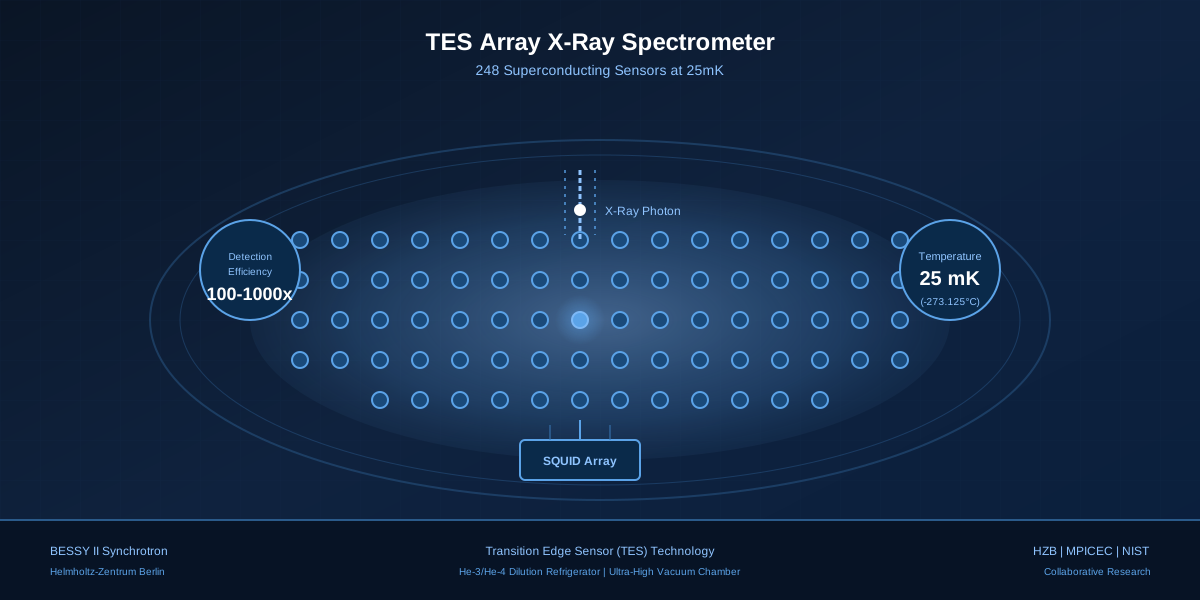
The new TES spectrometer fundamentally changes this equation. With its 248-sensor detector array operating at temperatures just 25 millikelvin above absolute zero, the system can detect individual X-ray photons with unprecedented sensitivity. This dramatic improvement in detection efficiency—between 100 and 1,000 times better than traditional wavelength-dispersive spectrometers—means experiments that once required hours can now be completed in minutes.

How Cryogenic Superconductivity Enables Precision Detection
The heart of this breakthrough lies in the exploitation of superconducting phase transitions. Each of the 248 sensors is cooled to 25 millikelvin using a sophisticated helium-4/helium-3 dilution refrigerator—similar to the cryogenic systems employed in quantum computers. At these temperatures, the sensors exist in a delicate superconducting state.
When an X-ray photon strikes one of these sensors, it deposits a tiny amount of energy that briefly raises the sensor's temperature above its superconducting threshold. This minute temperature increase disrupts the superconducting state, causing a measurable change in electrical resistance. The system detects these resistance changes through an array of Superconducting Quantum Interference Devices (SQUIDs)—the same ultra-sensitive magnetic field sensors used in applications ranging from medical imaging to gravitational wave detection.
The integration of this detector with a custom ultra-high-vacuum sample chamber allows researchers to transfer, prepare, and measure samples across a temperature range from 10 kelvin to room temperature. The entire setup is installed at the BESSY II UE52-SGM beamline, where scientists can also precisely control the polarization of incoming X-rays.
Transforming Scientific Possibilities
The implications of this technological leap extend across multiple scientific disciplines. Dr. Regis Decker, the HZB scientist responsible for the new instrument, explains that the system will provide unprecedented insights into molecular chemistry, molecular biology, and quantum materials. It also serves as a powerful complement to angle-resolved photoemission spectroscopy (ARPES), the widely-used technique for investigating electronic band structures.
Perhaps most significantly, the TES spectrometer removes long-standing sample size barriers. Researchers can now investigate:
- Atomically thin layers – Two-dimensional materials like graphene and transition metal dichalcogenides
- Nanostructures – Quantum dots, nanowires, and other nanoscale systems
- Impurities – Trace elements and defects in otherwise pure materials
- Highly diluted molecular systems – Biological samples and chemical compounds at low concentrations
These capabilities address fundamental limitations that have constrained X-ray spectroscopy for decades. The ability to study smaller, more dilute samples will accelerate discoveries in fields ranging from materials science to pharmaceutical development.
Experimental Efficiency and Throughput
Beyond opening new scientific frontiers, the TES spectrometer dramatically improves experimental efficiency. Measurements that traditionally required hours of synchrotron beam time can now be completed in minutes. This acceleration has multiple benefits:
Increased Sample Throughput: Scientists can investigate more materials in a given time window, accelerating the pace of discovery and enabling more comprehensive screening studies.
Dynamic Studies: Faster measurements enable time-resolved experiments that capture transient phenomena—chemical reactions in progress, phase transitions, or the response of materials to external stimuli.
Accessibility: Experiments that were previously impractical due to beam time constraints now become feasible, democratizing access to cutting-edge synchrotron capabilities.
Collaborative Innovation: HZB, MPICEC, and NIST
This achievement represents the culmination of collaboration between three major research institutions: Germany's Helmholtz-Zentrum Berlin (HZB), the Max Planck Institute for Chemical Energy Conversion (MPICEC), and the U.S. National Institute of Standards and Technology (NIST). This international partnership brought together expertise in superconducting detector technology, synchrotron instrumentation, and cryogenic systems.
The collaboration model exemplifies how complex scientific instrumentation increasingly requires distributed expertise. No single institution possesses all the necessary capabilities—from detector fabrication to cryogenic engineering to synchrotron beamline integration. The success of the TES spectrometer demonstrates the value of sustained international partnerships in pushing the boundaries of experimental science.
Commercial and Industrial Implications
While primarily a scientific instrument, the TES spectrometer technology has broader implications for industry and commerce:
Semiconductor Development: The ability to characterize atomically thin layers and nanostructures with unprecedented precision will accelerate the development of next-generation electronic devices.
Pharmaceutical Research: Structural characterization of protein complexes and drug-target interactions at low concentrations could streamline drug discovery pipelines.
Materials Quality Control: Advanced spectroscopic techniques enabled by high-efficiency detection could improve quality control in advanced materials manufacturing.
Energy Storage: Detailed characterization of electrochemical interfaces could accelerate battery and fuel cell development.
The Road Ahead
Dr. Decker and his team are now inviting the international scientific community to submit research proposals for experiments using the new instrument. The user community at BESSY II spans diverse fields including physics, chemistry, biology, and materials science—all of which stand to benefit from the TES spectrometer's capabilities.
As synchrotron facilities worldwide continue to push for higher brilliance and more sophisticated instrumentation, the TES spectrometer at BESSY II represents a significant milestone. It demonstrates that substantial improvements in detection efficiency—orders of magnitude beyond conventional approaches—are achievable through cryogenic superconducting technology.
For Europe's scientific community, this instrument provides a unique capability that complements existing facilities. While other synchrotrons continue to operate conventional spectrometers, BESSY II now offers researchers access to detection sensitivity that was previously unattainable.
Conclusion: A New Era in X-Ray Spectroscopy
The activation of Europe's first TES-array X-ray spectrometer marks the beginning of a new era in X-ray analysis. By achieving 100 to 1,000 times better photon detection efficiency than conventional systems, this instrument removes fundamental barriers that have constrained research for decades.
For organizations working at the intersection of advanced materials, quantum technologies, and molecular characterization, the implications are significant. The ability to study smaller samples, detect trace components, and complete experiments faster will accelerate innovation across multiple sectors.
As research proposals begin flowing in and the first experiments commence, the scientific community will discover what new phenomena become visible when detection sensitivity increases by three orders of magnitude. The answers promise to reshape our understanding of matter at the atomic and molecular scale.
Source: This article is based on research conducted at Helmholtz-Zentrum Berlin (HZB) and published in collaboration with the Max Planck Institute for Chemical Energy Conversion and the U.S. National Institute of Standards and Technology. The TES spectrometer is now operational at the BESSY II synchrotron.
